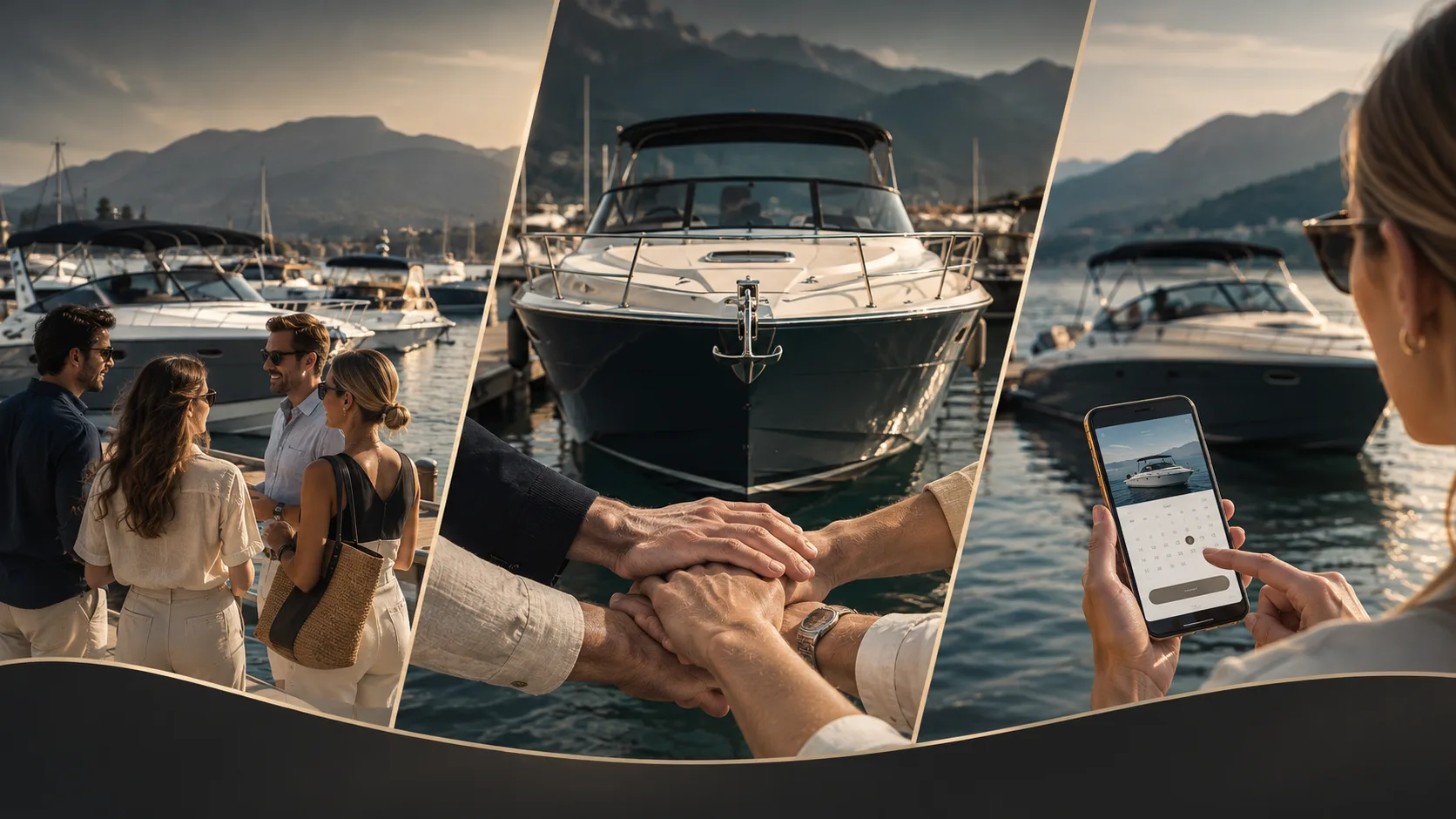
We all know the feeling: you want to enjoy a beautiful day on the lake, bring friends or family on board, cut the engine at anchor and take your time. But do you really need to buy your own boat to enjoy these moments? Not necessarily.
Between the purchase price, the marina berth, insurance, maintenance and repairs, owning a boat is a commitment of both money and time. And if you only go out a few days a month, or even a few weeks a year, the question is worth asking.
A boat club, co-ownership and rental offer different ways to share the costs and access to boating. But be careful: these three solutions do not work the same way. Some put simplicity first, others freedom or investing together.
At MB74, we believe a boat should above all remain a pleasure. Here is what you need to know to choose an option that suits the way you boat, with no unpleasant surprises when the bill arrives.
1. The boat club: boating without managing your own boat
The idea behind a boat club is simple: you join an organization that makes several boats available to its members. You reserve a boat based on availability, you climb aboard and you enjoy your outing.
You do not own the boat. In return, you generally avoid most of the hassle of maintenance, winterization, mooring and paperwork. These services are handled by the operator, within the limits set out in its offer and contract.
It is an attractive option for people who want to boat regularly without spending their evenings organizing services, looking for a marina berth or dealing with unexpected technical problems.
How does a boat club work?
How it works varies from one club to another. Most often, access to the fleet is based on a membership, sometimes with a joining fee and usage fees for each outing.
Once you are a member, you reserve a boat according to the club's rules. Some clubs offer several categories of boats. You can then choose a model suited to a family outing, a relaxed cruise or a day of water sports, depending on the fleet available.
But don't stop at the number of boats advertised. What matters is their actual availability on the water you boat on, on the dates when you are free.
How much does a boat club cost?
There is no single price. The cost depends on the region, the type of boats, the services included and how you are billed. To know your real budget, ask for a written breakdown of the fees.
- Any registration or joining fee.
- The monthly or annual membership.
- The cost of each outing, if charged separately.
- Fuel and consumables.
- The security deposit and the conditions under which a deductible applies.
- Any surcharges for certain models or certain periods.
- The cancellation and rescheduling terms when the weather does not allow boating.
Let's take a purely illustrative example: with an annual membership of €1,500 and outings charged at €150 each, ten days on the water add up to €3,000 before any additional fees. These amounts do not reflect an average market price: they are only there to show how to calculate the total cost.
The right calculation is to add up all the foreseeable fees and divide them by the number of days you realistically expect to spend on the water.
The advantages of a boat club
- Less to manage: routine maintenance and logistics are generally handled by the club.
- A clearer budget: you know the fees included in your plan, apart from variable expenses.
- Several models to choose from: depending on the fleet, you can pick a boat suited to your plans.
- Easier access to boating: you avoid having to finance a boat and its equipment on your own.
The drawbacks to know before you sign
The main thing to watch is availability. Sunny Saturdays in July and August are in high demand. If you can only go out on weekends, you need to know how far in advance you will have to book.
Also look at pick-up and return times, the authorized boating areas, the terms of use and the rules in the event of damage. Ask what happens if the boat you reserved becomes unavailable or if an outing has to be canceled because of the weather.
Finally, a boat club does not necessarily guarantee complete freedom. You are using a shared fleet, with common rules. You won't always be able to leave at the last minute, always choose the same boat or leave your gear on board.
2. Co-ownership: buying a boat with others
Co-ownership works on a different principle: several people buy a boat together and each holds a share in it. They share the initial investment, the running costs and the organization of who uses the boat when.
This option can be particularly attractive if you want a specific boat, plan to use it regularly and know other boaters you can organize things with.
You keep a real connection with the boat: you help choose the equipment, you know its history and you have a say in its maintenance. In return, you have to learn to share decisions as much as expenses.
A concrete example of a shared budget
Let's imagine three people buying a €60,000 boat together, with equal shares.
| Item | Total amount | Share per person |
|---|---|---|
| Purchase price | €60,000 | €20,000 |
| Shared annual costs, as an example | €9,000 | €3,000 per year |
In this example, each co-owner puts in €20,000 for the purchase, then contributes €3,000 a year to the shared costs. Purchase or financing fees are not included.
Depending on the group's choices, the annual budget can cover the marina berth, insurance, routine maintenance and a reserve for repairs. Fuel and consumables can be paid separately by each user.
Note: these amounts are fictitious and are not an estimate of typical costs. The real budget depends on the boat, its age, its engine, its condition and where it is kept.
You also need to plan ahead for major maintenance work, equipment replacement and resale value. A year without a breakdown does not guarantee the following ones will be just as smooth.
The advantages of co-ownership
- A shared initial investment: each person finances part of the purchase price.
- Shared costs: common expenses are split according to the rules agreed between the owners.
- A boat chosen together: you decide on the model and equipment based on your needs.
- A real connection with the boat: you can follow its history, its maintenance and how it evolves.
The tricky part: getting organized between co-owners
On paper, everyone agrees. But who gets the boat on the Bastille Day weekend? Who pays when a piece of equipment breaks? Can you install a new electronics system without asking the others? And what happens if one of the co-owners wants to sell their share?
These questions need to be settled before the purchase, while everyone is still available to discuss them calmly.
We recommend putting at least the following points in writing:
- Ownership shares: who holds which share and how the contributions are split.
- The schedule: how weekends, public holidays and vacations are booked.
- Expenses: which costs are shared and which are tied to individual use.
- Repairs: who approves quotes, how emergencies are handled and how costs are split.
- Decisions: which decisions require everyone's agreement and which can be made according to an agreed rule.
- A co-owner leaving: how their share can be transferred and on what terms.
- Renting to third parties: if it is allowed, how it is organized and what consequences it has for insurance and any applicable obligations.
What legal structure should you use to buy a boat together?
The word “co-ownership” is often used in everyday language, but on its own it does not describe the legal structure chosen. Several people can, for example, hold a boat in joint ownership (“indivision” under French law) or choose a structure suited to their project.
The consequences for decision-making, transfer of shares, liability and management vary depending on the framework chosen. It is therefore important to clearly define each person's rights and obligations, rather than relying on a simple verbal agreement.
Insurance also deserves a careful check. Make sure the policy matches the boat's ownership and the intended uses. If you want to rent the boat out to other people, explicitly check the coverage conditions and any additional obligations before going ahead.
3. Rental: the freedom to boat without an annual commitment
Rental is the most straightforward option: you book a boat for a day, a weekend or a week, you pay the agreed price and you return it at the end of the rental period.
You don't have to finance the purchase or handle maintenance as an owner. On the other hand, you must follow the terms of the contract, the return times and the applicable boating rules.
Depending on the boat and the provider, rentals can be offered with or without a skipper. Requirements regarding a boating license, experience or training depend in particular on the boat, its engine, the boating area and the rental company's conditions.
Why rental makes sense for occasional use
Planning a few outings a year? Spending a week's vacation by the lake? Want to organize a day with friends without committing for several seasons? Rental is often a good place to start.
You pay for the time you use, without carrying the costs of ownership all year round. You can also choose different models depending on your plans, within the limits of what is available.
Rental is also an excellent way to try out several types of boats before buying. Cockpit comfort, storage, how easy it is to move around on board and how the boat handles are things a spec sheet doesn't always let you judge.
Which fees should you check?
The advertised price is not necessarily the final amount. Before booking, check the following points:
- Is fuel included or charged at the end of the outing?
- Are cleaning, preparation or administration fees added?
- What security deposit is required?
- What deductible do you have to pay in case of damage?
- What insurance coverage is included and what are the exclusions?
- What safety equipment and accessories are provided?
- What are the terms for cancellation, late return or early return?
To illustrate the calculation, a day charged at €300 comes to €1,200 for four days, before any additional fees. This figure is an example of the calculation, not an average market price.
To compare several offers, add up the mandatory fees and those you will most likely have to pay. A slightly more expensive rental can turn out to be better value if it includes more services.
The drawbacks of renting
Availability is often the first obstacle in peak season. The most popular boats can be booked several weeks in advance. If you want to go out on a Saturday in July or over a long weekend, it is best to plan ahead.
You also have to accept using the boat provided, with its equipment and its rules. You won't necessarily get the same model for every outing or be able to leave your gear on board.
Finally, renting does not mean that every risk is covered. The contract may include a deductible, exclusions or specific obligations in case of damage. Read the terms before you set off and ask for clarification if anything is unclear.
4. Boat club, co-ownership or rental: the comparison
All three options let you enjoy a boat without necessarily financing the purchase on your own. But the constraints, the responsibilities and the freedom of use are different.
| Criterion | Boat club | Co-ownership | Rental |
|---|---|---|---|
| Ownership of the boat | No | Yes, shared | No |
| Initial investment | Membership and any fees | Share of the purchase price | No purchase |
| Recurring costs | Membership and usage fees depending on the plan | Shared running costs, maintenance and repairs | Only when you book, excluding extra fees |
| Availability | Depends on the fleet and bookings | Depends on the schedule agreed between owners | Depends on the boats available |
| Choice of boat | Among the club's models | The boat bought together | Depends on what is available for each booking |
| Maintenance and management | Generally handled by the club | To be organized between owners | Generally handled by the rental company, depending on the contract |
| Customization | Limited | Possible, depending on the agreements between owners | Limited |
| Commitment | Depends on the membership terms | Investment and collective commitment | One-off |
| Ideal profile | Regular boater who wants less hassle | People who want to own a boat together | Occasional or undecided boater |
This comparison shows the general trends. Contracts can significantly change the terms of use and the costs. Before choosing, compare the actual services, the booking rules and the responsibilities involved.
5. How do you know which option offers the best value?
The best method is to compare expenses over the same period, for example one season or several years, then divide them by the number of days you actually spend on the water.
Cost per day used = total cost over the period ÷ number of days actually spent on the water.
This calculation alone is not enough to decide, but it avoids a misleading comparison between a membership, a share of a purchase and a daily rate.
For a boat club
Add up the registration fees, memberships, cost of outings, fuel and any surcharges. Then check that the slots you need are actually available. An unused membership is still an expense.
For co-ownership
Include the purchase price, any purchase and financing fees, annual running costs, maintenance, repairs and a reserve for exceptional expenses.
To compare with the other options, think over several years and take into account the boat's estimated resale value. The capital tied up and its depreciation are part of the true cost of ownership.
For rental
Multiply the full cost of an outing by the number of days planned. Add travel and accommodation costs if your plans require them. If you are considering a whole week, also compare weekly rental rates with those for several separate days.
6. The questions to ask before signing
Whatever you choose, take the time to check the terms before you commit. Here are the questions that deserve a clear answer.
- What is the total cost over a year, including fixed and variable fees?
- Which dates can I book during the busiest periods?
- What happens if the weather prevents boating or if the boat is unavailable?
- Who covers damage, repairs and the insurance deductible?
- What qualifications or experience are needed to use the boat?
- Where are you allowed to take the boat?
- What is the procedure in case of a breakdown, damage or late return?
- How can I end the commitment if my needs change?
For a boat club, look in particular at the booking rules and the cancellation terms. For a rental, check the security deposit, insurance exclusions and cancellation terms. For co-ownership, clarify the decision-making rules, how costs are split and how a share can be sold.
7. Our view: choose how you will use it before choosing your boat
If you only go out a few days a year, rental often lets you enjoy the water without carrying the ongoing costs of an owner.
If you go out regularly and want to avoid day-to-day management, a boat club can be a good compromise. Provided, of course, that the fleet, prices and available slots match your expectations.
If you want a specific boat, use it regularly and can organize things with reliable partners, co-ownership is worth considering. It lets you share the investment while keeping a real connection with the boat. But it requires a solid agreement, good communication and rigorous management.
At MB74, our advice is simple: start from the way you boat, not just from the boat you dream of. How many days will you really be on the water? On which dates? What budget can you devote to this passion each year? And above all, do you want to manage a boat or simply enjoy one?
A boat that stays in the marina because its cost or logistics are too much of a burden does nobody any good. Conversely, a well-chosen option can let you get out on the water more often and with greater peace of mind.
If you finally decide to buy your own boat, take the time to compare models, their condition and their maintenance costs. You can also explore our pages on the Nautique brand, boat service and repair and used boats for sale.
FAQ: frequently asked questions about sharing a boat
What is the cheapest way to go boating?
It all depends on the number of outings, the boat and the terms offered. For a few days a year, rental spares you the fixed costs of ownership. A boat club can be worthwhile for regular use. Co-ownership spreads the investment and running costs, but involves an initial contribution, maintenance costs and a resale risk. Compare the total cost rather than just the advertised price.
Can you book a boat club boat at the last minute?
It depends on the club and on availability. Some slots may be free, while weekends and vacations are often in higher demand. Check the booking rules and cancellation terms before you sign up.
Can two or three people buy a boat together?
Yes. Several people can own a boat together, under a suitable legal framework. It is important to put in writing how shares, expenses, bookings and decisions are divided, as well as how a co-owner can leave.
Who pays for repairs on a co-owned boat?
How costs are split depends on the agreed rules, the circumstances of the damage and the insurance. Shared costs can be divided according to the shares held or according to another explicit agreement. The procedure needs to be defined before a breakdown or damage occurs.
Does a rental always include insurance and fuel?
No. Fuel may be charged separately and coverage varies from one contract to another. Check in particular the deductible, the exclusions, the security deposit and the conditions for covering damage.
Can a co-owned boat be rented out to other people?
Not automatically. You need to check the agreement between the co-owners, the insurance terms and the rules that apply to operating the boat. Renting to third parties can bring specific obligations. Get the plan approved before counting on rental income to cover the running costs.
Do you need a license to use a shared boat?
The requirements depend in particular on the boat, its engine, the boating area and the applicable rules. A club or rental company may also require a minimum level of experience or additional training. Check the conditions before your first outing.
Can you try several boats before buying?
Yes. Rental lets you discover different sizes and layouts and compare comfort, handling, storage and space on board. It is a good way to check your real needs before committing to a purchase.
At MB74, we are convinced there is no single right way to enjoy your passion for boating. What matters is choosing an option that makes you want to cast off more often, without turning the pleasure of boating into a financial or logistical burden.