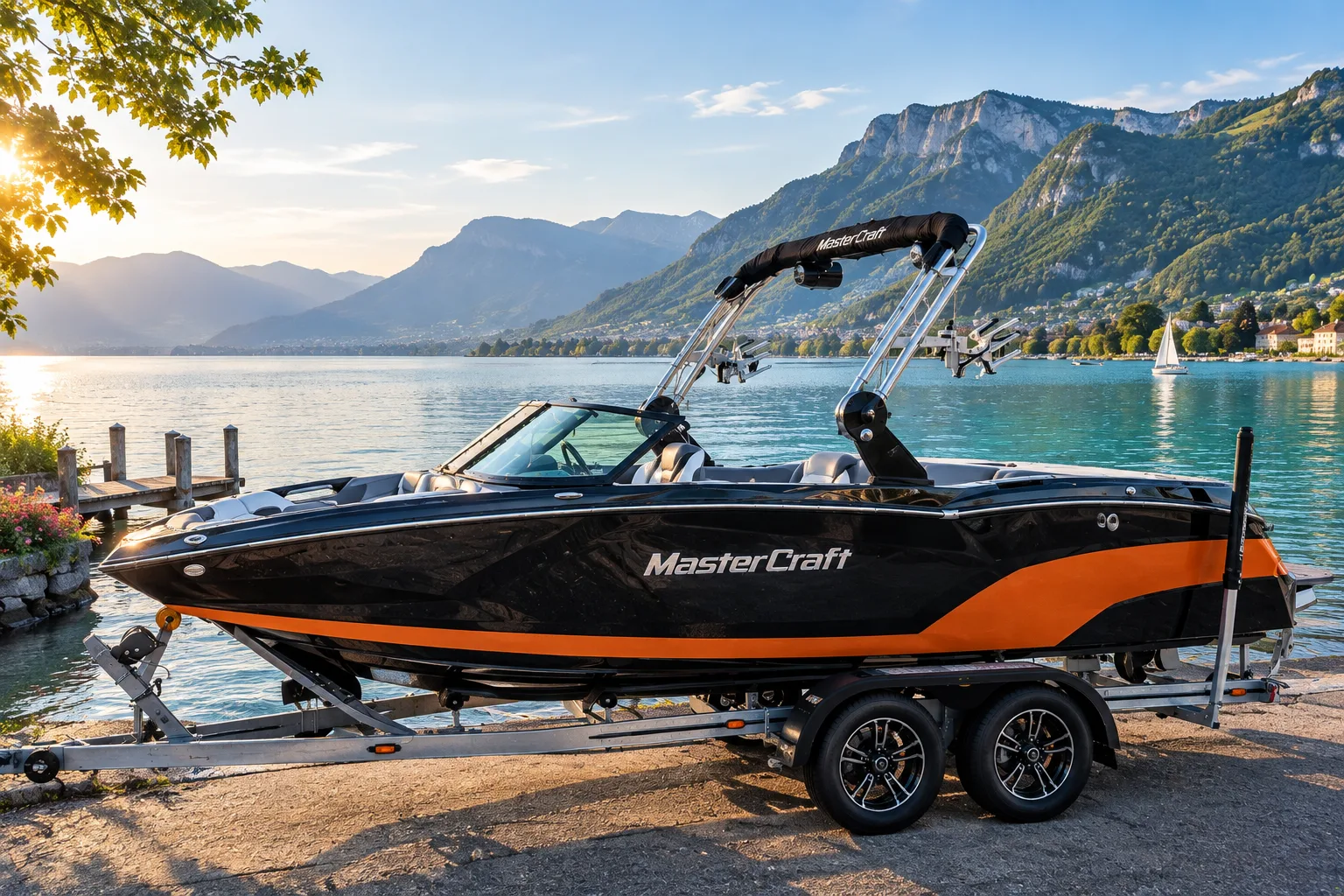
Two boats from the same year can therefore have very different values. Real condition and how well the boat has been serviced often make the difference.
When you’re thinking about selling your boat, the question comes up fast: how much is it worth today?
For an inboard boat, answering it properly takes a little more than browsing a few listings online. The engine, the transmission, the hours on the water and the maintenance account for a large share of the value. Cosmetic condition matters too, as do the equipment and the demand for the model in question.
A ten-year-old inboard with a fully documented service record can be easier to sell than a newer boat with a vague history. Conversely, a transmission that needs servicing or very tired upholstery can bring the price down noticeably.
The goal of a serious estimate is therefore not to find the highest possible price. It is to arrive at a value consistent with the boat’s real condition and the current market.
What determines the value of an inboard boat?
There is no universal depreciation rate that applies to every boat. Instead, value comes from a combination of factors that can offset each other or stack up.
| Criterion | What to look at |
|---|---|
| Model and model year | Reputation of the model, generation, demand and market positioning |
| Engine | Make, horsepower, generation and condition of the engine |
| Engine hours | Amount of use and consistency with the boat’s history |
| Maintenance | Regularity of services, invoices and work carried out |
| Transmission | Condition of the V-drive, the propeller shaft or whatever drive system is used |
| Hull | Gelcoat, repairs, impacts, possible water intrusion |
| Upholstery | Wear, fading, tears and overall condition |
| Equipment | Options fitted, their condition and real appeal to buyers |
| Storage | Winterization conditions and how the boat has been kept |
The key is not to look at these criteria in isolation. 1,000 hours on a properly maintained engine don’t tell the same story as 500 hours with poorly documented maintenance.
Do engine hours really bring down the value of an inboard?
Yes, they count. But on their own, they can’t determine the price.
A buyer looks at the hours because they give an indication of how much the engine has been used. They will then want to understand how those hours were built up and, above all, how the engine was maintained.
To assess this criterion properly, look in particular at:
- the total number of hours;
- how the hours have built up season after season;
- the regularity of oil changes and services;
- major work already carried out;
- any alarms or faults;
- the condition of the transmission and ancillary components.
The listings currently offered by Motor Boat 74 illustrate this logic well. The 2008 Super Air Nautique 220 is listed at €49,500 with 1,600 hours and a 330 hp PCM Excalibur V8. By contrast, the 2018 Moomba Mondo Surf Edition shows 715 hours and €79,500, with a 400 hp Indmar V8. These two examples obviously aren’t directly comparable, but they show why year and hours are never enough on their own.
Why does the service history change the estimate?
It is probably one of the most underestimated factors in a private sale.
A buyer isn’t just buying a boat. They are also buying a clearer picture of the costs ahead of them after the sale.
A file containing the service invoices, oil changes, work on the engine and transmission, and repairs done on the hull considerably reduces that uncertainty.
Conversely, when there is no way of knowing when the engine was serviced or whether certain work was really done, the buyer will generally factor that risk into their offer.
At Motor Boat 74, the workshop handles the service and diagnostics of inboard and outboard engines, as well as mechanical, electrical and hull repairs.
Explore boat service and repair in Annecy
How do you compare your boat with used boat listings?
Listings are essential for getting a first idea of the market. But be careful: an asking price isn’t necessarily a final sale price.
To get a useful comparison, look for boats as close as possible to yours:
- same make and model;
- similar model year;
- comparable engine;
- similar number of hours;
- equivalent equipment;
- comparable overall condition;
- similar geographic area.
The Motor Boat 74 used boat inventory can serve as a concrete point of comparison, notably because the listings show the model year, the engine and, when provided, the number of hours.
For example, the 2019 Super Air Nautique G23 is currently listed at €148,000, with a 450 hp PCM 6.2L and 1,200 hours. It is a good example of why an inboard’s value must always be judged within its segment: a G23 obviously can’t be compared directly with an older or more compact model.
How much weight should you give the engine and transmission?
On an inboard, this is a particularly important point.
The engine accounts for a major share of the boat’s mechanical value, but don’t forget everything around it: cooling, exhaust, transmission, V-drive or propeller shaft, depending on the configuration.
A sought-after, properly maintained engine can support the boat’s value. Conversely, major work on the horizon can quickly change the equation.
A leak, unusual play, a vibration or a transmission noise won’t necessarily show up in the photos of a listing. Yet they can mean a significant expense for the next owner.
That is why a serious professional estimate should ideally come with a mechanical inspection, particularly on an older or heavily used boat.
Do options always increase the price of a boat?
No. And it is a common mistake in estimates made by owners themselves.
It is tempting to add up the price of the boat when new and that of every option added over the years. But the used boat market doesn’t work that way.
An option mainly holds its value when buyers are looking for it and it is still in good condition.
On a wake boat or a wakesurf boat, a ballast system, a tower, an audio system or certain comfort features can make a model more attractive. But their original purchase price won’t be fully recovered at resale.
So the right question is rather:
“Does this option really make my boat more appealing to a buyer today?”
Does the condition of the hull and upholstery affect the price?
Yes, sometimes significantly.
A clean, well-maintained hull without major, poorly documented repairs inspires confidence. Conversely, heavily marked gelcoat, impacts or a structural repair can immediately raise questions.
Upholstery also plays a big part in how a boat is perceived. On a wake, ski or wakesurf boat, it is highly exposed to UV and repeated use. Open seams, sagging foam or heavily faded vinyl can therefore weigh on the negotiation.
You do need, however, to distinguish normal wear due to age from a problem requiring a real refurbishment.
A few cosmetic flaws shouldn’t be assessed in the same way as water intrusion, a structural repair or upholstery that needs to be entirely redone.
Do storage and winterization affect the value?
They don’t automatically translate into a quantifiable discount, but they are part of the boat’s history.
A boat hauled out at the end of the season, properly prepared, protected from frost and stored in good conditions has a reassuring history. Conversely, several years spent outside without maintenance can lead to more inspections and more work.
For an inboard, winterization is particularly important since it covers the engine, the cooling circuits and the transmission.
In Annecy, Motor Boat 74 offers a boat storage and winterization service with engine preparation and secure 3,000 m² indoor boat storage.
Keeping invoices and maintenance records is therefore useful when it comes time to sell. They let you demonstrate the boat’s condition instead of simply claiming it.
How do you work out a first estimate for your boat?
To start, pick three to five boats that are genuinely comparable to yours.
Then note down the key information:
| Item | Your boat | Comparable 1 | Comparable 2 |
|---|---|---|---|
| Make / model | To fill in | To fill in | To fill in |
| Model year | To fill in | To fill in | To fill in |
| Engine hours | To fill in | To fill in | To fill in |
| Engine | To fill in | To fill in | To fill in |
| Transmission | To fill in | To fill in | To fill in |
| Overall condition | To fill in | To fill in | To fill in |
| Equipment | To fill in | To fill in | To fill in |
| Asking price | n/a | To fill in | To fill in |
This method lets you define a market range. On its own, it can’t tell you the exact value of your boat.
If your boat is particularly clean, mechanically sound and fully documented, it can sit at the top of that range. Conversely, an upcoming service, tired upholstery or an incomplete history will need to be factored into the estimate.
Why is the trade-in price different from the sale price?
This is an important distinction when you ask a professional for an estimate.
Trade-in value and the private sale price are not the same calculation.
When a dealer takes a boat in trade, they have to plan for its inspection, its preparation, any repairs, storage, marketing costs and the risk tied to how long it will take to resell.
The trade-in value can therefore be lower than the price at which the boat will later be offered after preparation.
At Motor Boat 74, trade-ins are accepted on all makes. The website explains that the value is estimated by the technicians, taking into account in particular the hull, the engine, the hours and the upholstery, and then deducted from the purchase of a new or used boat.
See Motor Boat 74 used boats and trade-in service
Which faults can sharply lower the value of an inboard?
Not all faults have the same impact.
- missing or very incomplete service history;
- engine with a fault or a recurring alarm;
- overheating or cooling problem;
- leak on the engine or transmission;
- high hours without documented maintenance;
- major, poorly documented hull repair;
- badly worn upholstery;
- faulty electronics;
- trailer in poor condition when it is included in the sale;
- no records for the main work carried out.
Conversely, a purely cosmetic flaw that is easy to fix won’t necessarily have the same impact on value as a mechanical or structural problem.
Should you have your boat surveyed before selling it?
Not always.
For a recent, well-maintained boat that is easy to compare with similar models, a professional estimate together with a mechanical inspection can already provide a good basis.
An independent marine survey can, however, be worthwhile when the boat has a high value, an unusual history, structural repairs, or when there is a disagreement about its condition.
Either way, an inspection provides information that listings can’t: the boat’s real condition.
How do you prepare your boat for an estimate?
The more complete the file you give the professional, the less the estimate relies on assumptions.
You can also note the major work done over the last few seasons. A recently serviced transmission, new upholstery or documented mechanical work are far more convincing to mention with an invoice to back them up than with a simple line in the listing.
At Motor Boat 74, used boats are prepared by the workshops before going on sale, with a mechanical, hull and upholstery inspection.
Which used boats can you use as price references?
The best way to understand how the market works is to look at models actually for sale, rather than theoretical examples.
At the time of writing, the Motor Boat 74 inventory lets you compare several inboard profiles:
- 2008 Super Air Nautique 220: €49,500, 1,600 hours, 330 hp PCM Excalibur V8;
- 2018 Moomba Mondo Surf Edition: €79,500, 715 hours, 400 hp Indmar V8;
- 2019 Super Air Nautique G23: €148,000, 1,200 hours, 450 hp PCM 6.2L.
These boats obviously shouldn’t be treated as three interchangeable reference values. They belong to different generations, categories and equipment levels. Their value lies elsewhere: they show in concrete terms the difference in value that the model, the engine, the positioning and the condition of a boat can make.
To broaden the comparison, also take a look at all the used boats currently offered by Motor Boat 74. The selection changes regularly, which is precisely why it pays to use real listings rather than a theoretical price guide.
So how do you get a realistic estimate for your inboard boat?
The right estimate isn’t necessarily the one with the highest number. It is the one that matches the boat’s real condition and the market it is aimed at.
Start by looking for comparable models, then look closely at the engine hours, the engine, the transmission, the condition of the hull, the upholstery and, above all, the service history.
Then distinguish between three things: the price you would like to sell the boat for, the price asked by competing sellers, and the trade-in value a dealer can offer you.
These three amounts can differ without any of them necessarily being wrong.
For an inboard, the mechanical inspection remains particularly important. A beautiful hull and low hours aren’t enough to know the condition of an engine or a transmission.
If you are thinking of selling your boat to move up to a newer model, Motor Boat 74 can look at taking it in trade, whatever its make, and then deduct its value from your next purchase.
FAQ
How do I know how much my inboard boat is worth?
Start by comparing boats similar in model, year, engine, hours and condition. Then factor in the service history, equipment, hull, upholstery and transmission. For a more accurate estimate, a professional can inspect the boat.
Do engine hours necessarily reduce a boat’s value?
No. Hours mainly indicate how much the boat has been used. They should be interpreted together with the maintenance carried out and the condition of the engine and transmission.
Are options taken into account in the price of a used boat?
Yes, but they generally don’t recover their purchase price. Their impact depends on how useful they are, their condition and how much buyers of that model want them.
Why is a dealer trade-in offer lower than a listing price?
The dealer has to factor in the cost of inspection, preparation, any repairs, storage and marketing. The trade-in price and the final sale price are therefore two different calculations.
Should you have your boat serviced before selling it?
Not always. A service can be worthwhile if it documents the mechanical condition or fixes a fault that would seriously hurt the sale. On the other hand, a big expense made only in the hope of raising the price doesn’t always pay off.
Does Motor Boat 74 take inboard boats of all makes in trade?
Yes. Motor Boat 74 accepts trade-ins on boats of all makes. The estimate is made by the technicians based in particular on the hull, the engine, the hours and the upholstery.