You've found the right boat, the asking price is slightly over your budget and you're unsure: should you offer less, and on what basis? Many buyers negotiate on instinct, then run into a seller who won't budge. Others sign too quickly and only later discover costs they could have raised. On the used boat market, it pays to prepare the price discussion the way you would build a case.
What is the asking price based on?
A listing price is an intention to sell, not a value. The seller set it by looking at other listings, thinking about what they've invested, and sometimes leaving some room for negotiation. Your first job is therefore to work out a realistic price range.
Compare boats that are genuinely equivalent: same model and generation, same engine, similar year, comparable equipment (ballast, upholstery, electronics, boat trailer). Note the engine hours, the stated condition and where the boat has been stored. Keep in mind that you're comparing asking prices: a boat that has been listed at a high price for a long time is not a benchmark; if anything, it shows what the market has refused.
What is negotiable, and what isn't?
Not all arguments carry the same weight. A seller will listen to a repair quote, far less to an “I saw it cheaper elsewhere” with no specific reference. The table below ranks common arguments by how solid they are.
| Argument | Strength | How to use it |
|---|---|---|
| Work needed, confirmed on inspection (worn upholstery, damaged propeller, boat trailer needing repair) | Strong | Present a quote or written estimate, item by item |
| Undocumented maintenance (no invoices, uncertain service history) | Strong | Ask for the paperwork; failing that, get a price for a catch-up service |
| Lower comparable listings | Medium | Cite two or three genuinely equivalent boats, not a vague average |
| Equipment advertised but missing or not working | Strong | Have it listed in the offer and the bill of sale |
| Boat listed for a long time | Weak to medium | Handle with tact: it tells you how flexible the seller is, not what the boat is worth |
| Buyer's limited budget | Weak | Don't use it as an argument; it changes nothing about the boat's value |
Engine hours deserve a special mention. Low hours are reassuring, but they say nothing about how regularly the boat was serviced or about long periods of inactivity. What matters is the gap between what the hour meter suggests and what the invoices prove.
How do you work out how much to offer?
The best way to negotiate the price of a used boat is to start from the asking price and subtract specific items, rather than putting forward a round number. The following example is purely illustrative: the amounts are calculation assumptions, not prices, and do not constitute an offer.
| Item | Starting assumption | Amount (€) |
|---|---|---|
| Asking price | Seller's listing | 55,000 |
| Engine and cooling system service | No recent invoice, quote to be obtained | – 1,500 |
| Upholstery to be redone | Worn seats, quote to be obtained | – 1,800 |
| Boat trailer tires and lights | To be repaired before use | – 600 |
| Well-argued offer | Asking price minus the priced work | 51,100 |
This offer is based on €3,900 of estimated work. The seller can dispute an item, offer to carry out the repair themselves or come back with a figure in between: the discussion becomes concrete, and everyone knows what they're talking about. Replace the assumptions with real quotes before making your offer.
Private seller or dealer: is the negotiation the same?
With a private seller, the room for negotiation mainly concerns the price and the condition you observe. The seller knows their boat and can tell you its story, but they don't always have the paperwork or the inclination to spend time on inspections. The discussion is therefore built on trust, which you need to turn into written evidence.
With a professional seller, the starting price often includes other things: preparation, inspections, sometimes a warranty. The lever then isn't always the discount; it can be what the service includes. Ask what is included and have it written into the sales document, rather than assuming. The seller's obligations (warranty, disclosure of the boat's condition) differ depending on whether they are a private individual or a professional: have them confirmed before you sign, as these rules depend on your situation (French law).
What can you negotiate besides the price?
A seller who refuses to lower the price will sometimes give ground elsewhere. That's often more useful: a concession on reconditioning is worth as much as a price cut, and it doesn't challenge the value the seller places on their boat.
- Reconditioning before delivery: service, replacement of a wear part, thorough cleaning.
- Accessories: boat trailer, cover, life jackets, anchor, water sports gear, to be listed one by one.
- Logistics: launch, boat transport, winterization for the first season. For the boat service and repair work to plan after the purchase, compare quotes during the negotiation, not afterwards.
- Timing: handover date, how long the offer stays valid, contingencies (test drive, marine survey, financing).
If you're financing the purchase, a financing contingency protects your offer. The different options, from a conventional loan to a lease with purchase option (LOA), are compared in our article on financing a used boat.
When is the best time to negotiate on Lake Annecy?
The season affects the mindset of both parties. In summer, a seller who is still enjoying their boat holds firm on price, and you can test drive it on the water in good conditions. In fall and winter, a boat sitting on land may prompt its owner to sell before paying for another winterization, but the weather and the temperature make a test drive harder.
Either way, add a test drive on the water as a condition of the offer, with the engine warm, watching how it revs up, how it behaves under full load and whether any alarms come on. Also ask where and how the boat was stored: an engine that has been properly winterized doesn't carry the same risk profile as a boat left outside without protection. And in fresh water, the hull doesn't take the same punishment as at sea, which changes the checkpoints.
How do you secure the deal once you've agreed on a price?
A price agreed verbally protects no one. Put in writing the identity of both parties, the boat's identification, the price, the date of sale, the equipment included and the payment terms. The official template for an bill of sale for a pleasure boat (French administration) helps make sure nothing is forgotten, whatever the type of boat.
The formalities for transferring ownership (declaration of sale, registration in the buyer's name) go through the official French government portal Démarches Plaisance. Check with the authorities which documents are required for your boat, as they vary depending on its length, its power and its registration.
Already shopping and would like an opinion on a specific boat, or a look at the boats available? Our team can help.
FAQ
How much can you negotiate off a used boat?
There is no percentage that applies to every boat. The margin depends on the gap between the asking price and comparable listings, the condition observed, the paperwork available and how motivated the seller is. An offer backed by quotes stands a better chance of being heard than an arbitrary figure.
Do you need a marine survey before buying a used boat?
It is strongly recommended when the history is incomplete or the budget is significant. Its cost should be weighed against the price of the repairs it can help you avoid. You can make it a contingency of your offer, so you can walk away or renegotiate depending on its findings.
Can you renegotiate after the test drive?
Yes, provided you planned for it. If the test drive reveals a defect that wasn't mentioned, you can ask for a lower price, a repair before the sale, or walk away. Making it clear from the outset that the offer is subject to the test drive avoids any surprises.
Can you pay a deposit to reserve a boat?
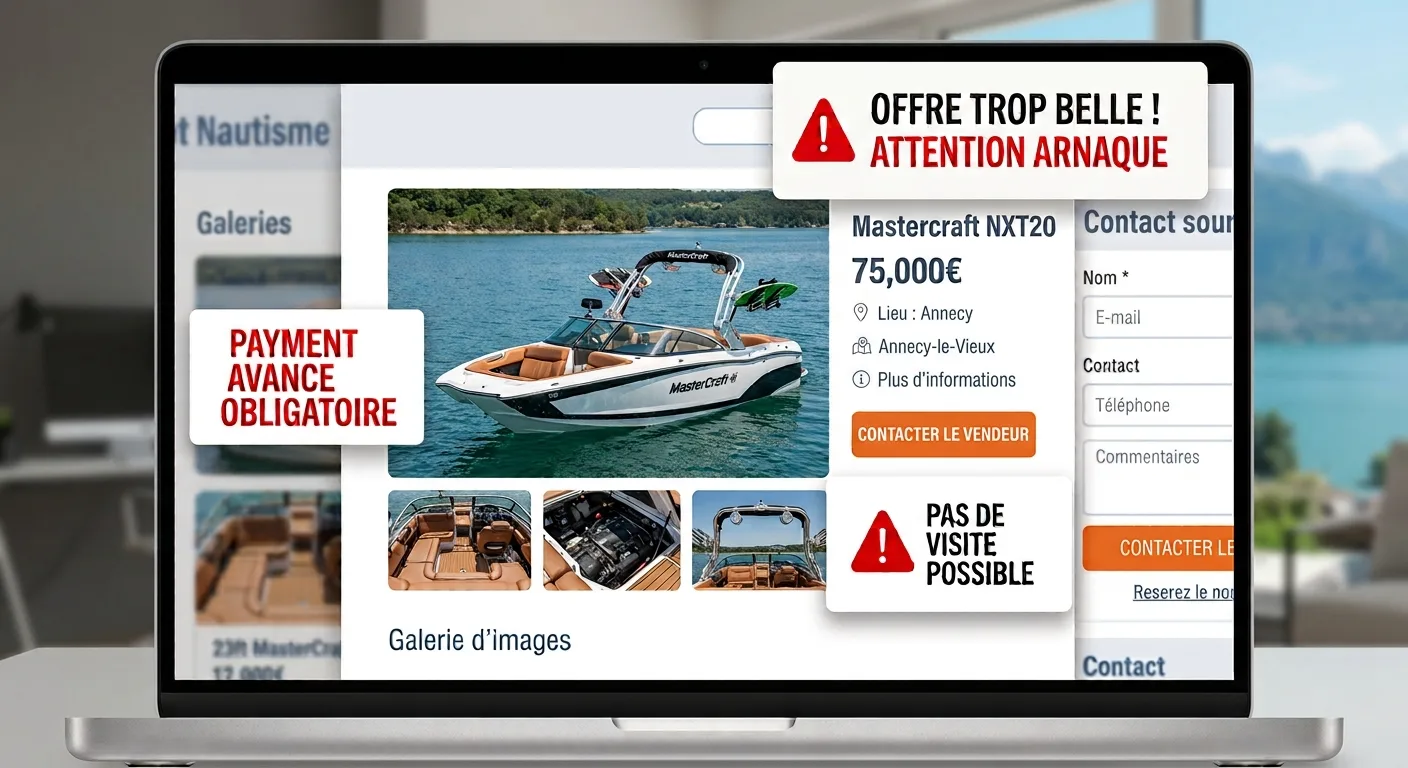
You can, but only after seeing the boat and with a written document stating the amount, its purpose and the conditions for getting it back. Refuse to pay before any viewing or on the mere promise of delivery.
Is negotiating different with a dealer?
Often, yes: the discussion focuses less on the discount than on what is included (preparation, inspections, warranty, boat trailer). A professional seller's obligations differ from those of a private seller, which is why it pays to ask in writing what the price includes.