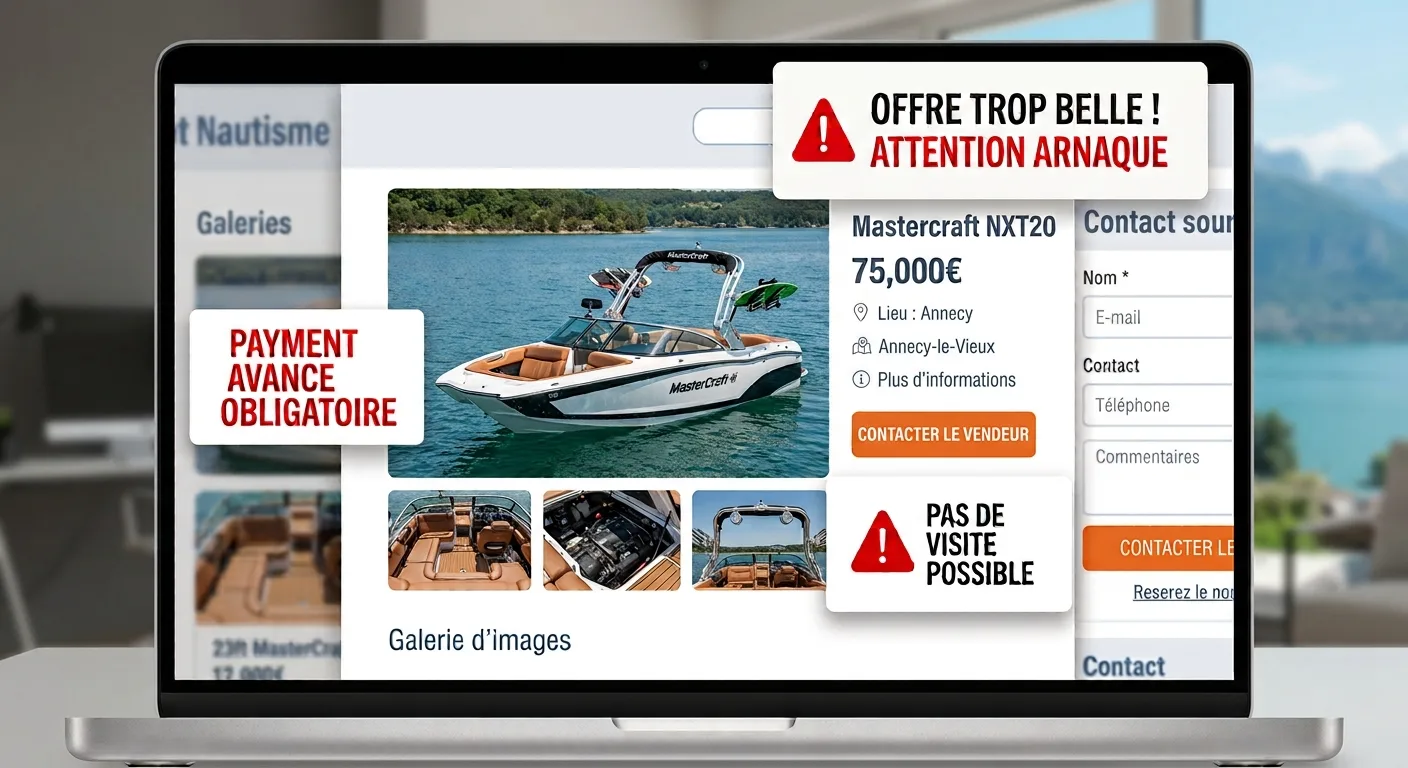
You find a boat that fits your budget, the photos are convincing and the seller says he has already received several offers. He suggests you reserve it right away by paying a deposit. This is exactly the moment to slow down.
A used boat scam online can start with a copied listing, a false identity or a believable story designed to get you to pay before you can check the boat. The risk increases when all contact happens through messages and the seller refuses to meet.
Whether you are looking for a boat on a specialist platform or considering a private boat sale, the goal is the same: to tell a deal that is simply attractive from a transaction that carries real risk. Here are the checks to carry out before you commit, leaving the in-depth technical inspection for a separate step of your purchase.
How do you spot a used boat scam online?
The first thing to do is check whether the offer adds up, rather than trusting how good it looks. A low price is not proof of fraud: the boat may be old, need repairs or be priced for a quick sale. However, a price well below that of comparable models calls for a clear explanation.
Compare several listings for boats of the same model, a similar year and with comparable engines and equipment. Factor in the stated condition and any work the boat will need. If the seller cannot explain the price difference, do not rush.
Watch out in particular for these red flags:
- Artificial urgency: the seller says you must pay within the hour or lose the deal.
- No viewing possible: he claims to be abroad or unavailable and refuses to let someone you trust see the boat.
- Questionable photos: the images are very generic, do not show the features listed or seem to appear in several different listings.
- A story that keeps changing: the information about where the boat is, who owns it or how it will be delivered does not add up.
- A middleman of the seller's choosing: the seller insists on going through a shipping company, payment service or reservation system that he chose himself.
A single warning sign is not always enough to conclude that it is fraud. However, several inconsistencies together are a good reason not to go any further until you have received verifiable answers.
Check the listing and the seller's identity
A used boat listing can be copied from the website of a professional or a legitimate owner. The fraudster then reuses the photos and description of a real boat, but with his own contact details, in order to collect a deposit.
To limit this risk, ask for recent photos of specific details: the dashboard, the engine, the identification plate or a piece of equipment mentioned in the listing. You can also suggest a live video call to see the boat and ask questions. This does not replace a viewing, but it can reveal inconsistencies.
If you think the photos have been reused, run a reverse image search or search the internet for a distinctive sentence from the listing. If the same boat appears elsewhere with another seller or a different price, ask for an explanation before going further.
Next, check who you are dealing with. Ask for the seller's name, contact details and consistent information about the boat's ownership. If he is acting on behalf of someone else, clarify his role and ask how his authority to sell can be verified.
Searching for “suspicious boat seller” can help you plan your online checks, but do not rely on a single result or a handful of reviews. Look up the contact details you were given through several channels and be wary of pages or documents that may themselves have been copied.
For a professional, check the company's details and official contact information. For a private seller, make sure their identity and role in the sale are consistent with the available documents. An email address or a profile on a platform is not, on its own, proof of ownership.
Which documents should you check before paying a deposit?
The documents involved in selling a boat depend in particular on the type of vessel and its administrative status. So you should not apply a one-size-fits-all list without checking the formalities that apply to the boat in question.
Ask to see the applicable identification or registration documents, the proof that the seller is entitled to sell the boat, and any available service invoices. The information must match the boat being shown and the details in the listing.
Before signing or paying a deposit, check in particular:
- that the available identification references match the boat being shown;
- that the seller can prove his right to sell the vessel;
- that the advertised specifications do not contradict the documents you have seen;
- that the equipment included in the price is clearly described;
- that the status of the boat trailer is clear if it is part of the sale.
A missing invoice or a document still to be completed does not automatically prove fraud. However, a significant inconsistency or a refusal to provide the necessary proof must be resolved before you pay. If you are not sure which formalities apply, consult an official source or ask a qualified professional for advice.
Keep a copy of the listing and of your written exchanges. They let you find the advertised specifications, any defects that were mentioned and the terms agreed with the seller.
How do you pay for a used boat safely?
Paying for a used boat is a step to prepare, not a formality to rush through. Before any payment, you need to know exactly who is receiving the money, on what basis and under what conditions the boat will be handed over to you.
If a deposit is part of the deal, ask for a written agreement that identifies the parties and the boat, states the amount paid, the total price, the equipment included and the conditions that apply in case of cancellation. What happens if one side withdraws can depend on the nature of the payment and on what was agreed: do not assume that a deposit is automatically refundable.
Check that the payee matches the person you are contracting with. If the bank details change at the last minute or the seller asks you to pay someone whose role is unclear, hold off on the transfer until the situation has been checked through an independent channel.
Also be careful with payment links received by message, requests for verification codes and so-called escrow or delivery services. Do not treat a logo, an email or a payment page as proof that the service is legitimate. Look up the provider's official contact details yourself and check how it works.
The guidance from the DGCCRF (French consumer protection authority) on avoiding online shopping scams stresses in particular the value of checking the seller's identity, comparing offers and not giving in to artificial sales pressure.
What should you do if you suspect fraud?
If you spot a serious inconsistency, stop the transaction. Do not pay any additional sum to release a delivery, cover an unexpected insurance fee or recover a first payment. These requests can extend the financial loss instead of solving the problem.
If you have already paid, contact your bank quickly to report the situation and ask what steps are still possible. Your options depend in particular on the payment method, how much time has passed and the circumstances. Getting your money back is not guaranteed.
Keep the listing, the messages, the contact details you were given, the documents received and the proof of payment. Do not delete the exchanges, even if the seller closes his account or stops replying.
You can visit Cybermalveillance.gouv.fr for advice on online scams (French government service). Depending on the situation, a report or a police complaint may also be necessary.
If you have not paid yet, do not try to get the seller to reassure you. Ask for verifiable proof. If he refuses, walking away from the listing is often a safer decision than taking a financial risk you cannot control.
Don't confuse fraud with a boat in poor condition
A transaction can be perfectly honest and still involve a boat whose condition does not meet your expectations. Conversely, a real boat and an identifiable seller do not guarantee that the price is justified or that every defect has been disclosed.
Checking the listing and the payment is therefore no substitute for a technical inspection before buying. For everything related to choosing the model, the hull, the mechanics, the service history and the test drive, read our guide to buying a used boat in Annecy and Haute-Savoie. The two articles complement each other: this one covers fraud risks and buying at a distance; the guide helps you examine the boat itself.
If you would rather start from boats offered by a marine professional, you can also browse the used boats for sale at Motor Boat 74. Take the time to ask your questions and clarify the terms of sale before making your decision.
FAQ
How can you tell if a used boat listing is a scam?
An unusually low price, pressure to pay, a refusal to let you see the boat or inconsistent documents are all warning signs. Check several points independently and do not send any money until the main doubts have been cleared up.
Is buying a boat from a private seller risky?
Not necessarily. The risk depends on how reliable the information is, on checking the seller, on the boat's condition and on the terms of the transaction. Take the time to put agreements in writing and check the documents before making any payment.
Which documents should you ask the seller for?
Ask for the applicable identification or registration documents, any available proof of ownership and the service invoices. The exact formalities depend on the boat and its administrative status.
Should you pay a deposit to reserve a boat?
A deposit can be agreed, but it should never be paid under pressure. First check the seller and the documents, then put the amount, the purpose of the payment and the cancellation terms in writing. Do not pay if the payee or the conditions remain unclear.
What should you do after wiring money to a fraudulent seller?
Contact your bank immediately to report the transaction and ask what options are available. Keep the evidence, the listing and the exchanges, then consult the official resources on online scams to find out the right steps for your situation.
Does a genuine listing guarantee that the boat is in good condition?
No. Checking the listing and the seller helps reduce the risk of fraud, but it cannot confirm the boat's mechanical or structural condition. A viewing and, depending on the boat, an independent inspection remain separate steps.
Useful sources
- DGCCRF: preventing online shopping scams (in French).
- Cybermalveillance.gouv.fr: advice on how to respond to an online scam (in French).