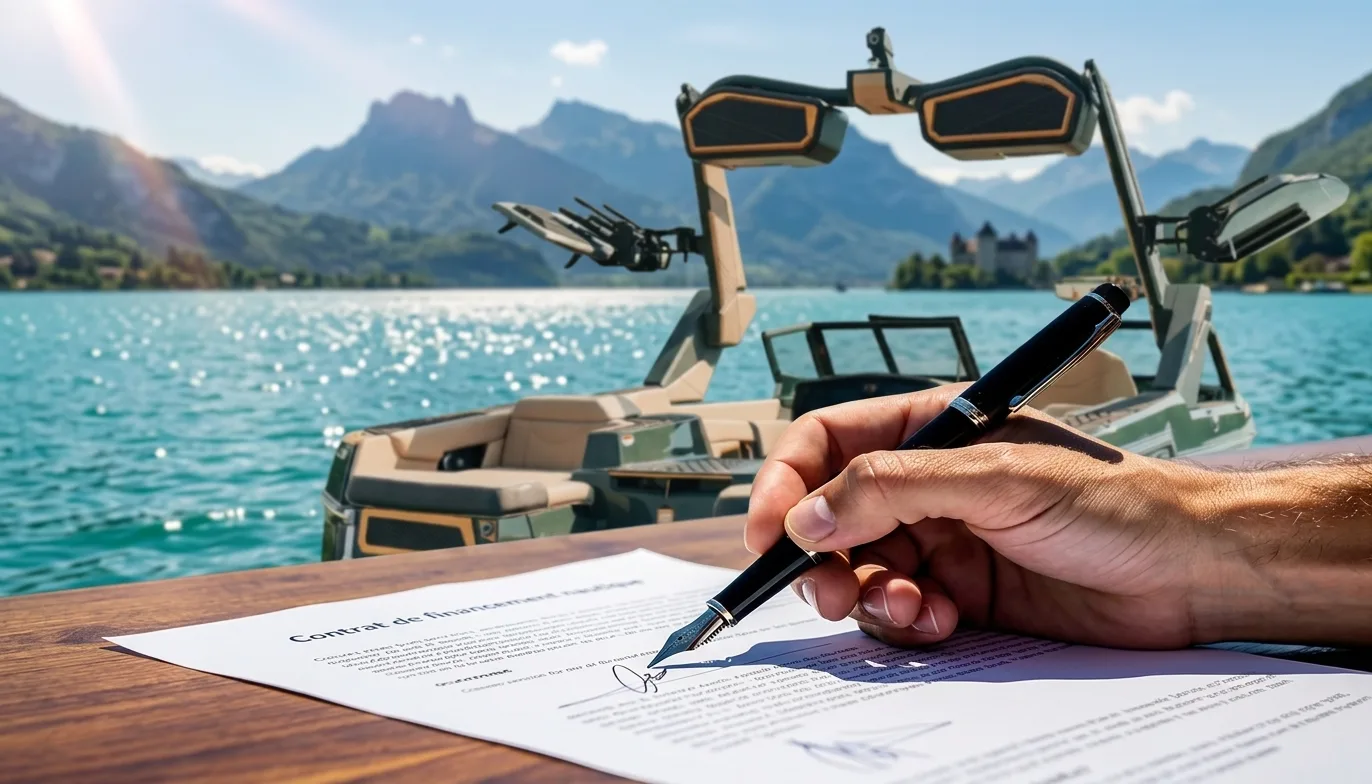
Buying a used boat is often a chance to get out on the water in a bigger, better-equipped or higher-performing model than a new boat would allow for the same budget. But even on the pre-owned market, it remains a significant investment. And when you don’t want to tie up all your savings, the question of financing quickly comes up.
Should you take out a boat loan? Go for a personal loan? Look for a leasing offer or an LOA (lease with option to buy)? And above all, can any used boat really be financed with these solutions?
Financing should be chosen the same way as the boat itself: based on how you plan to use it, your practical constraints and your real budget. Here is how to compare the options without being won over by an attractive monthly payment alone.
1. Before choosing financing, define the boat’s real budget
The first instinct is often to start from the price shown in the listing. That’s understandable, but not enough. A used boat priced at €35,000 does not necessarily cost €35,000 once it is ready to go out on the water.
Depending on its condition, equipment and history, it may need an engine service, new batteries, upgraded electronics, upholstery work or work on the hull and safety equipment.
So even before comparing loans, you need to separate three budgets:
- The purchase price: the amount paid to the seller, minus any down payment.
- The commissioning budget: a possible marine survey, a service, immediate work, missing equipment, transport or launching.
- The annual cost of ownership: insurance, mooring or boat storage, maintenance, winterization, fuel, boating fees and unexpected repairs.
2. A traditional boat loan: the clearest path to ownership
A loan is generally the first type of financing to look at when the goal is to buy a used boat and keep it for several years. The lender finances all or part of the purchase, and the borrower then repays the principal and interest according to a schedule set out in the contract.
Depending on your application and the offers available, two options in particular can be considered: a loan tied to the purchase of the boat and a personal loan.
The purchase-linked boat loan
A purchase-linked loan is tied to a specific purchase. The funds are earmarked for the boat named in the contract, and the financing is legally linked to the sale. For a purchase from a professional, this option can offer an attractive framework, provided the seller and the boat meet the lender’s conditions.
Before applying, check:
- whether financing is offered for a used boat;
- whether the seller can be a private individual or must be a professional;
- whether the age, price and type of boat meet the lender’s criteria;
- whether equipment, work or additional fees can be financed;
- what the conditions are for releasing the funds and for delivery.
A purchase-linked loan can be relevant when the financing and the sale are closely linked. The protections that apply, however, depend on the contract and the legal framework of the transaction: read the terms rather than assuming all loans are the same.
The personal loan
A personal loan lets you borrow a sum you can use freely, within the limits of the contract. It can therefore be an option for financing a boat bought from a private seller, and also certain costs related to the project if the amount granted allows it.
Its flexibility is its main advantage. On the other hand, it does not necessarily come with the same terms as a purchase-linked loan. You need to compare the annual percentage rate (APR, called TAEG in France), the application fees, any insurance offered and the total amount to be repaid.
A personal loan is not automatically more expensive or easier to obtain: it depends on your application, the lender and the features of the financing.
The advantages of a traditional boat loan
- You become the owner: once the purchase is complete, the boat belongs to you, subject to any guarantees or security interests provided for in the financing.
- You stay in control of how it is used: you can generally plan your time on the water without the return constraints that come with a lease.
- You can resell the boat: you will, however, need to take into account the outstanding principal and any guarantee held by the lender.
- You can keep the boat for a long time: once the loan is repaid, the monthly payments disappear, but the costs of ownership remain.
Drawbacks to plan for
A loan finances the purchase, not complete peace of mind. You remain responsible for maintenance costs, repairs and the boat’s depreciation. If a major breakdown happens shortly after the purchase, the monthly payments generally remain due.
A longer repayment term can lower the monthly payment, but often increases the total cost of interest. It can also leave you with outstanding principal while the boat’s resale value has dropped.
3. Boat leasing: a solution that depends on the contract
The term “leasing” is often used as a catch-all word for financing repaid through monthly lease payments. In practice, you need to look at the exact mechanism offered: a lease with an option to buy (LOA), finance leasing in a business context or another type of financial lease.
In a lease arrangement, the finance company or lessor remains the owner of the boat for the duration of the contract. The user makes lease payments to use it. Depending on the contract, they may then be able to buy it, return it or continue with another arrangement.
Be careful: leasing is not automatically available for a used boat. Some finance companies may restrict their offers to certain sellers, certain boat ages or specific categories of goods. So check that the boat is eligible before building your budget around this option.
Why consider leasing?
Leasing may appeal to a boater who wants to have a boat for a set period without committing to a definitive purchase from the outset. It can also spread cash outflows differently from a traditional boat loan.
But a lower monthly payment does not necessarily mean the financing is cheaper. The down payment, the total lease payments, fees, return conditions and any buyout price must be looked at together.
Questions to ask before signing
- Who legally owns the boat during the contract?
- Does the contract include an option to buy, and at what price?
- Can the boat be used under all the conditions of your intended use?
- Who pays for maintenance, repairs, insurance and boat storage costs?
- Are there maintenance obligations or restrictions on use?
- What are the return conditions and the consequences of early termination?
The answers must be written in the contract or its appendices. A sales presentation does not replace the clauses that will actually apply.
4. LOA: lease first, possibly buy later
LOA, or lease with an option to buy (location avec option d’achat), works differently from a traditional boat loan. You make lease payments for a set period, then you can decide to buy the boat at the price set by the purchase option, if you want to keep it and if the contract allows it.
This distinction is essential: making lease payments does not mean you are gradually repaying a loan on a boat you already own. During the lease, the boat belongs to the lessor. Ownership only transfers if you exercise the option set out in the contract and pay its price.
Is an LOA possible for a used boat?
There is no universal answer. Whether an LOA is available depends on the finance company, the type of boat, its age, the seller, its value and the terms of the transaction. Some offers may cover used boats, while others do not accept them.
You also need to distinguish contracts intended for private individuals from those offered in a business context. The applicable rules, eligibility criteria and tax consequences may differ. For a private purchase, don’t automatically apply car financing practices to a boat.
The main advantage: keeping a decision open until the end of the contract
An LOA can make sense if you want to use a boat for several years while keeping the option to buy it later. Since the option price is set in the contract, you know in advance how much it will cost to become the owner, subject to the contractual terms.
This flexibility does, however, come at a potential cost: you have to add up the initial payment, all the lease payments, any fees and the purchase option price to know the cost of an eventual purchase.
Points to watch with an LOA
- The initial payment: check whether it is a larger first lease payment, a security deposit or another sum, as the refund terms are not the same.
- The option price: low lease payments can be offset by a high buyout amount at the end of the contract.
- Maintenance: the legal owner is not necessarily the one who bears all the costs. The contract sets out each party’s obligations.
- Returning the boat: if you don’t buy the boat, you need to know the return conditions, the expected condition and any fees that apply.
- Early termination: selling or ending the contract before its term may be restricted and costly.
5. Loan, leasing or LOA: how they compare for a used boat
| Criterion | Traditional boat loan | Leasing / LOA |
|---|---|---|
| Owner during the financing | The buyer, subject to any guarantees | The lessor or the owning institution |
| Availability for used boats | Depends on the lender and the type of loan | Depends on the offer, the boat’s age and the lessor’s criteria |
| Monthly payments | Repayment of principal and interest | Contractual lease payments, with a possible purchase option |
| Becoming the owner at the end | Yes, once the loan is repaid and the obligations are lifted | Only if the purchase option is included and exercised |
| Selling during the contract | Possible, subject to the outstanding principal and guarantees | Subject to the contract clauses and the lessor’s agreement |
| Maintenance and repairs | Paid by the owner | Split according to the contract; a large part may remain the user’s responsibility |
| Key point to compare | APR, total cost, term and outstanding principal | Initial payment, lease payments, fees, purchase option and return conditions |
This table shows the main differences in how they work. The exact terms always depend on the contract signed, and leasing or LOA offers are not always available for every used boat.
6. A concrete example: how much does it cost to finance a €30,000 boat?
Let’s take a deliberately simple example to understand the effect of interest. You have found a used boat listed at €30,000 and you want to finance its entire price over five years.
Let’s assume, purely for illustration, a loan of €30,000 over 60 months at a fixed borrowing rate of 6.5% per year, excluding insurance and additional fees. Under these assumptions, the monthly payment would be about €587, for total repayments of around €35,200, or roughly €5,200 in interest.
| Item | Illustrative example |
|---|---|
| Boat price | €30,000 |
| Down payment | €0 |
| Amount borrowed | €30,000 |
| Term | 60 months |
| Hypothetical annual borrowing rate | 6.5% fixed |
| Estimated monthly payment | About €587 |
| Estimated total repaid | About €35,200 |
| Estimated interest | About €5,200 |
These amounts are rounded simulations, not a financing offer or an average market rate. The actual cost will depend in particular on the APR, the application fees, any insurance taken out and the terms offered by the lender.
And that’s not all: this €587 a month does not include fuel, boat insurance, the marina, maintenance or repairs. Financing is only one part of your boating budget.
How do you compare this example with an LOA?
You would need a real LOA offer for the same boat or a comparable one. Take the first lease payment, add all the other lease payments, the mandatory fees and the purchase option price if you want to keep the boat. Then compare that total with the overall cost of the loan, without forgetting the fees that would be the same in both scenarios.
Comparing a loan payment with an LOA lease payment is not enough: the two contracts do not necessarily finance the same thing and do not leave you with the same status at the end.
7. The down payment: should you put money down or borrow more?
A down payment can reduce the amount borrowed, and therefore the interest to pay when the other terms stay the same. It can also make it easier to get your application approved, depending on the finance company’s criteria.
But putting all your money into the purchase is not always a good decision. A used boat can hold surprises, even when it looks clean and well maintained. An independent marine survey and a careful look at its history can help reduce the risks, without eliminating them completely.
Before using your savings, ask yourself three questions:
- How much will be left after the purchase to deal with a breakdown or a major repair?
- Does borrowing less reduce the total cost enough to justify shrinking that reserve?
- Is your budget still comfortable once the annual costs of ownership and household expenses are added?
So the right down payment is not necessarily the highest possible. It is the one that balances the cost of financing, financial security and the boat’s real needs.
8. Pitfalls to avoid when financing a used boat
Focusing only on the monthly payment
A low monthly payment can be achieved by extending the term, increasing the down payment or pushing part of the cost to the end of the contract. These mechanisms do not have the same consequences. Always compare the total amount to be paid and where you stand at the end of the term.
Forgetting the boat’s age
An older boat may be cheaper to buy, but some lenders set limits on age or on the financing term. The maximum term offered may be shorter, or the application may not meet the finance company’s criteria.
Check that the boat is eligible before committing to the seller, especially if your purchase depends on getting the financing.
Financing a boat without budgeting for work
An engine service, work on the transmission or replacing equipment can quickly add to the budget. An inspection suited to the boat you have your eye on can help identify certain risks and estimate the work ahead.
To plan this budget, also see our boat service and repair section.
Not planning for resale
If you think you will change boats in three or four years, the financing term matters as much as the rate. With a loan, you will need to compare the expected sale price with the outstanding principal and any exit fees. With an LOA, the termination, transfer or return terms depend on the contract.
A boat that sells for less than expected can make the whole deal more expensive than the monthly payment suggested.
Confusing boat insurance with borrower insurance
Boat insurance covers certain risks related to the boat and its use, according to the coverage you take out. Borrower insurance, when offered or required, covers certain risks affecting your ability to repay. They do not serve the same purpose.
With lease financing, also check whether specific coverage is required under the contract. Don’t assume the basic coverage of your boat insurance meets all of the lessor’s requirements.
Signing without reading the early repayment terms
A windfall, the sale of another asset or the wish to change boats may lead you to pay off your financing before its term. The early repayment conditions, any penalties and the steps involved must be checked before signing.
9. How to choose based on your boater profile
You want to keep your boat for a long time
A traditional boat loan deserves to be looked at first. You become the owner and, once the financing is over, you no longer have loan payments. However, the cost of ownership continues: maintenance, insurance, boat storage, repairs and fuel don’t go away.
You are buying from a private seller
A personal loan can be an option, as it is not tied to a specific seller in the same way as a purchase-linked loan. But compare the terms of several lenders and check the amount actually available, the total cost and the supporting documents required.
You want to keep the option of buying later
An LOA can be worthwhile if there is an offer suited to this used boat and if the contract matches your goal. You must, however, be prepared to respect the conditions of use and to decide, at the end of the term, whether the final purchase makes financial sense.
You plan to change boats regularly
Don’t automatically choose an LOA. Compare the cost of several lease cycles with that of successive purchases followed by resales. Depreciation, transaction costs and the exit price can weigh heavily in both scenarios. The right solution will depend on the type of boat and the actual availability of offers.
Your priority is to preserve your cash
Compare financing with paying cash, but don’t look only at the cost of interest. Keeping savings available can be valuable for absorbing the unexpected. Conversely, borrowing over too long a term to preserve cash you don’t really need can push up the overall cost for no good reason.
10. The MB74 checklist before you commit
- Has the boat been inspected, and is its maintenance history sufficiently documented?
- Does the finance company accept this boat, its age, its price and the type of seller?
- Is the financing conditional on the sale of a specific boat?
- What is the APR and what will the total amount repaid be?
- Which fees and insurance are mandatory or optional?
- What budget remains available after the down payment?
- Does the financing leave room for work and maintenance?
- What are the conditions for early repayment or exiting the contract?
- With an LOA, what is the final purchase price and what are the return rules?
- Will the monthly payment remain manageable for the full term of the contract, even if your expenses go up?
If you are still at the research stage, start by defining how you will use the boat and your full budget, then compare the models that match your needs in our selection of used boats for sale.
Conclusion: the best financing is the one that lets you enjoy the water with peace of mind
To finance a used boat, a traditional boat loan is often the simplest starting point when you want to become the owner and keep your boat. A personal loan can offer more flexibility depending on the seller and your application. Leasing and LOA can meet other goals, but their availability for a used boat must be checked case by case.
The real comparison is about total cost, ownership of the boat, resale options, additional fees and end-of-contract constraints. An attractive monthly payment does not make up for financing that is poorly suited to how you use the boat.
Above all, keep one rule in mind: your budget must not only let you buy the boat. It must let you maintain it, use it and enjoy the season without turning every outing into a financial calculation.
FAQ: financing a used boat
Can you finance a used boat with a loan?
Yes. Depending on the boat, the seller and your application, you can look at a purchase-linked loan or a personal loan. Criteria for age, amount, term and supporting documents vary from lender to lender.
Can you buy a used boat with an LOA?
It depends on the offers available. Some finance companies may accept used boats under certain conditions, while others limit their contracts to certain goods or sellers. You need to confirm the boat’s eligibility before counting on this solution.
What is the difference between a boat loan and an LOA?
With a traditional boat loan, the buyer becomes the owner of the boat purchased, subject to any guarantees. With an LOA, the lessor remains the owner during the lease, and the user can buy the boat at the end of the contract if the option is included and exercised.
Is boat leasing cheaper than a loan?
Not necessarily. You need to compare the down payment, the monthly loan or lease payments, the fees, any buyout price and the return conditions. A lower monthly payment does not automatically mean a lower total cost.
How much of a down payment should you plan for to finance a used boat?
There is no universal amount. The down payment required depends on the lender, the price, the boat and your application. You should also keep a reserve for work, maintenance and the unexpected after the purchase.
Can you sell a boat that is still being financed?
This is generally possible with a loan, but you need to check the outstanding principal and any guarantees before completing the sale. With an LOA or a lease, selling or exiting the contract depends on the clauses and the lessor’s agreement.
Does a financed boat need to be insured?
You need to check the legal obligations that apply to the intended use and the requirements of the lender or lessor. A financing contract may require specific coverage. Boat insurance and any borrower insurance cover different risks.
Useful sources for financing a used boat
Before signing up for financing, it is helpful to consult official resources (French government sites) to understand how credit works, what to check and the rules that apply. These links complement the article but do not replace a review of an offer suited to the boat you have in mind.
- Service-Public.fr: Purchase-linked loans (crédit affecté)
An overview of loans linked to a specific purchase and the rules governing this type of financing (French law). - Service-Public.fr: Personal loans
General information on how a personal loan works and what to look at before committing. - DGCCRF: Understanding the lease with option to buy (LOA)
Explanations of how an LOA works and the points to watch. This guide covers vehicles: the terms of an offer for a boat must be checked specifically with the finance company. - French Ministry of the Economy: All about consumer credit
A general resource to better understand the main forms of consumer credit and what to look at before signing.
Important: these resources present the general framework for consumer financing in France. They do not guarantee that a loan, lease or LOA will be offered for any given used boat. Eligibility criteria, fees and financial terms must be confirmed in the finance company’s written offer.
```