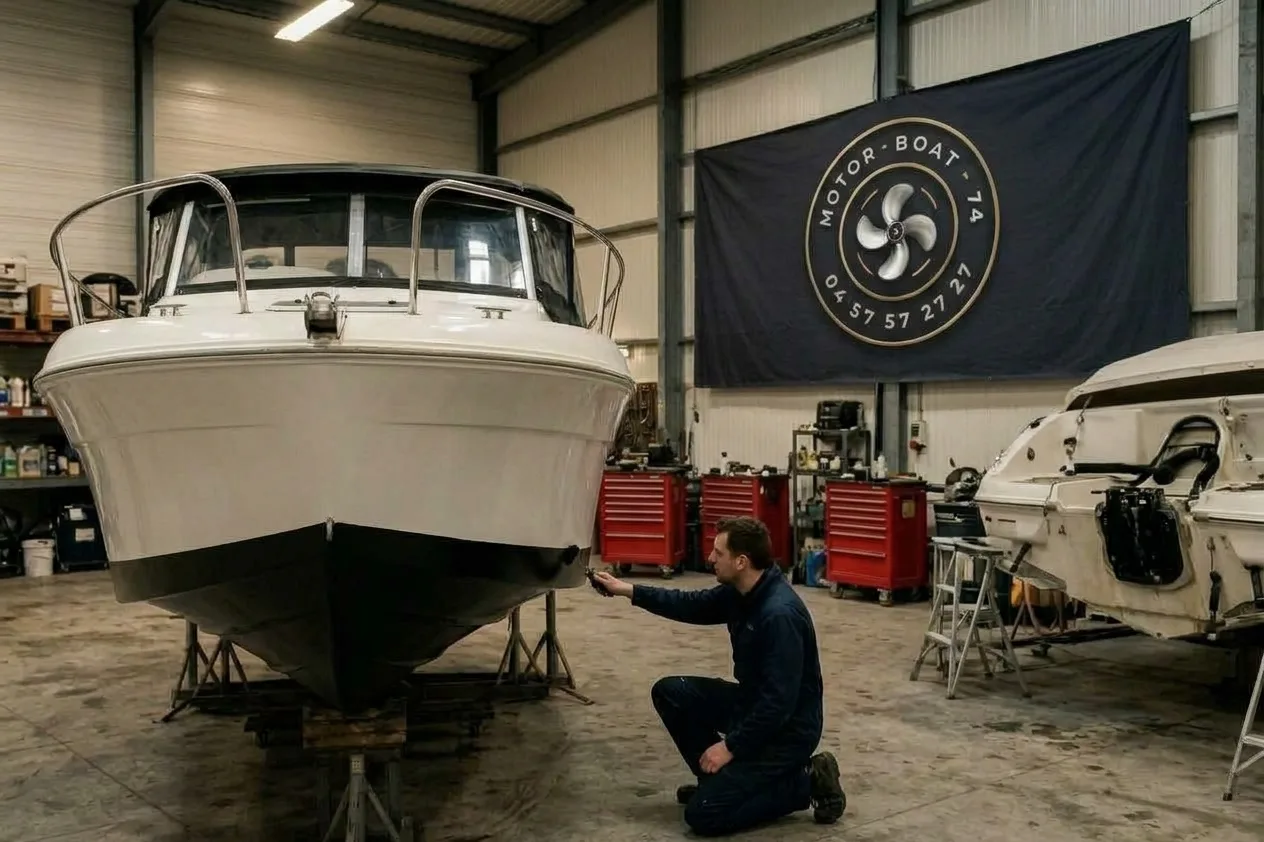
Boating in fresh water does not protect a fiberglass boat from osmotic blistering. That said, a preventive barrier coat is not always necessary. It depends mainly on the age of the hull, its condition, how long it has spent in the water over the years and how the boat is stored.
So before applying several coats of epoxy to a sound hull bottom, it is better to start by inspecting the hull and checking whether it really needs extra protection.
Whenever osmotic blistering comes up, one idea keeps coming back: “My boat runs in fresh water, so this doesn’t apply to me.”
That’s a shortcut best avoided.
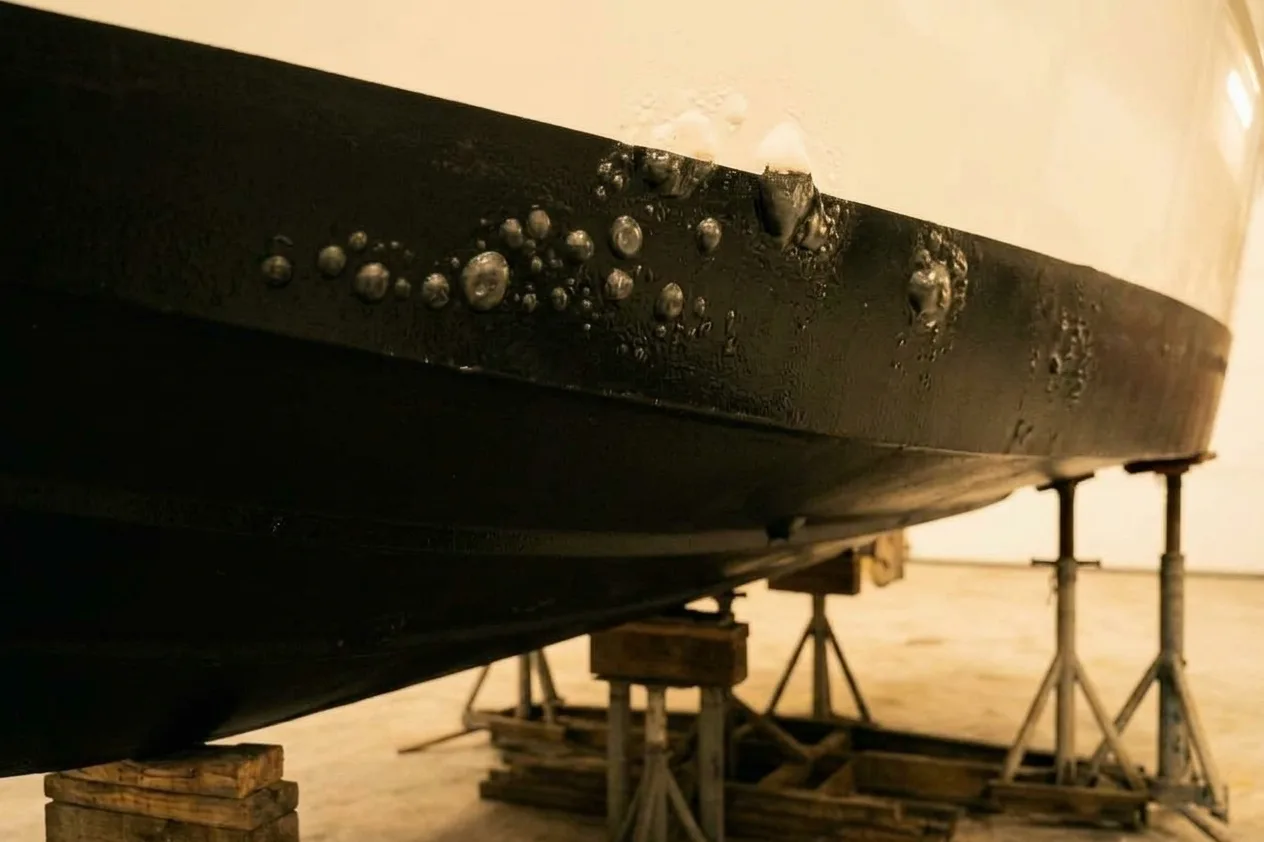
Osmosis, or osmotic blistering, mainly affects fiberglass hulls (glass-reinforced polyester). Water can gradually work its way through the gelcoat and react with certain components of the laminate. In some cases, this shows up as gelcoat blisters below the waterline.
So fresh water can be affected too. But that does not mean every boat that runs on a lake needs a barrier coat.
The right question is rather: what condition is the hull in, and what is its history?
Does fresh water really protect against osmotic blistering?
No.
Osmosis is linked to water getting into the gelcoat/laminate system and to the reactions that can occur with certain components of the resin. So the phenomenon doesn’t simply depend on whether the water is salt or fresh.
A fiberglass hull can show gelcoat blisters or other signs of osmosis after spending many years in a freshwater environment.
Temperature and time spent in the water also play a part. How the boat is used matters more than the simple “fresh water” or “salt water” label. Specialist technical sources point out in particular that warm water and prolonged immersion can increase the risk of osmotic blistering.
What is a preventive epoxy barrier coat?
First, two situations need to be told apart: preventing blistering on a sound hull, and treating a hull that already has a problem.
As prevention, the principle usually consists of applying a waterproof barrier coat to the hull bottom with a suitable epoxy system. This extra layer limits the migration of water through the gelcoat.
Systems such as International’s Gelshield 200, for example, are designed to provide a preventive barrier on fiberglass hulls. The manufacturer notably recommends this type of protection on new or very recent boats when you want to strengthen the protection of the laminate.
But this treatment is not just a quick coat of paint applied before the bottom paint.
Surface preparation, the number of coats, the resulting film thickness and the overcoating times are all critical for the system to work properly.
Does a boat used on Lake Annecy need a barrier coat?
Not automatically.
For a boat used on Lake Annecy, being in fresh water is not enough to decide on a treatment. What matters most is how the boat is used.
A boat that spends a few hours on the water and then regularly goes back into dry storage does not have the same profile as a hull that stays in the water for long months every year.
Likewise, a recent, perfectly sound hull for which the builder has already provided specific protection should not be treated the same way as an older fiberglass boat whose history is not precisely known.
Before making any decision, it is therefore worth checking:
- the age of the boat;
- the material and type of laminate used;
- whether there is an original epoxy protection;
- how much time the boat usually spends in the water;
- the periods of dry storage;
- the condition of the gelcoat below the waterline;
- any blisters, cracks or abnormal areas;
- the maintenance history of the hull bottom.
This assessment is often more relevant than a decision made only because the boat runs in fresh water.
When can a preventive treatment be worthwhile?
There are still situations where a preventive treatment can make sense.
The first is a new or very recent boat, when the builder has not already applied an epoxy barrier and the owner wants to strengthen the protection of the hull bottom before extended use in the water.
International precisely recommends considering preventive protection on a new or very recent hull, before it is launched for the first time.
Another situation: a boat that stays in the water for long periods. The longer the hull is exposed to water, the more the question of a barrier against moisture absorption deserves to be looked into.
Finally, treatment may be relevant when an older boat is about to change how it is stored, moving from mostly dry use to much longer immersion.
When is it better not to apply a barrier coat?
There are also situations where it is better not to treat right away.
The first is a sound hull whose existing protection is in good condition and that shows no particular signs. Adding an epoxy system can be worthwhile in some cases, but it isn’t a requirement just because the boat is made of fiberglass.
You should also avoid coating a hull whose moisture content is too high.
This is a key point: a waterproof barrier must not be used to seal a problem inside the laminate. When a hull has spent a long time in the water or shows signs of blistering, it must first be inspected and dried sufficiently before being treated.
Specialist manufacturers stress this drying stage: applying a barrier coat system to a laminate that is still too damp can cause the treatment to fail and the problem to come back.
How can you tell if a hull has osmotic blistering?
The first visual clue is often the appearance of small blisters below the waterline.
They may be isolated or numerous. Some are barely visible, while others form much larger areas.
There may also be traces of liquid inside the blisters or a characteristic smell when they are opened, but these observations alone are not enough to make a diagnosis.
A hull can also have defects that look like osmotic blistering without necessarily being caused by it. That’s why manufacturers recommend having the hull inspected when blistering appears.
On a boat with several blisters, suspicious areas or an unknown history, the right move is therefore not to sand right away and cover the hull bottom with epoxy.
You first need to understand what is going on.
What is the repair if osmotic blistering is already present?
Repairing confirmed osmotic blistering is very different from simple preventive protection.
Depending on the condition of the hull, it may be necessary to remove the bottom paint and part of the coating, or even to remove the affected gelcoat locally or more extensively. The hull must then be cleaned and dried before the protective system is rebuilt.
Drying time then becomes a major stage of the job. There is no single timeframe that applies to every boat: it depends mainly on the condition of the laminate, its moisture content and the storage conditions.
Once the surface is dry enough and prepared, a suitable epoxy system can be applied to recreate a barrier against water.
In other words, a barrier coat is not just a coat of paint meant to hide the blisters.
Do you have to remove the bottom paint before a barrier coat?
Yes: when a real hull bottom treatment is planned, the condition of the old coatings must be taken into account.
An epoxy system must be applied to a properly prepared surface. Old coatings that are incompatible or poorly bonded must be removed, and the gelcoat must be clean and prepared according to the specifications of the chosen system.
International notably recommends removing the bottom paint and old unsuitable coatings when a blistered hull is to be repaired.
This preparation also explains why a barrier coat is a much bigger job than simply renewing the bottom paint.
How many coats should be applied?
There is no universal number of coats that applies to every product.
Each epoxy system has its own recommendations for the number of coats, total dry film thickness, application temperature and intervals between coats.
For example, International specifies a minimum dry film thickness of 250 microns for its Gelshield 200, usually achieved with five coats in its reference system.
This figure should not be turned into a general rule for all products: the technical data sheet of the system used remains the reference.
Protection that is too thin or applied to a poorly prepared surface will not deliver the expected result.
Does a barrier coat replace bottom paint?
No.
The two products do not serve the same purpose.
| Product | Main function |
|---|---|
| Gelcoat | Finish and outer protection of the hull |
| Epoxy barrier coat | Limit water penetration into the hull system |
| Bottom paint (antifouling) | Limit the attachment and growth of organisms on submerged parts |
In a complete system, the protective epoxy can therefore sit under the bottom paint. However, the products and overcoating times must be respected to ensure adhesion between the different layers.
What if the boat is regularly kept in dry storage?
This is an important factor for boats used on a lake.
A boat that spends much of the year on its trailer, in indoor boat storage or in dry storage is not exposed to water in the same way as a hull that stays in the water all the time.
This difference must be taken into account before deciding on a preventive treatment.
Dry storage also makes it easier to inspect the hull bottom. With the hull accessible, it is easier to spot a blister, a crack, an old repair or an area where the coating is defective.
It is often this regular monitoring that makes it possible to make the right decision at the right time, rather than routinely treating “just in case.”
Should a new fiberglass hull be treated?
This is probably the case where the question is most worth asking.
On a new hull, the surface is still sound and accessible, which makes it much easier to apply a preventive system.
International in fact recommends applying a preventive system before the first launch when extra protection is wanted.
But before planning the job, you need to check what has already been done at the factory.
Some builders may have provided specific protection for the hull bottom. In that case, adding a new coat without knowing exactly what the existing system is doesn’t make much sense.
So the first question to ask when buying a new boat is: what hull bottom protection did the builder apply?
What should you check before deciding on a barrier coat?
So, is a barrier coat useful in fresh water?
Yes in some cases, but not across the board.
A boat that runs in fresh water can still develop osmotic blistering if it has a fiberglass hull. Fresh water is therefore no protection against the phenomenon.
On the other hand, the decision to carry out a preventive treatment should be based on the hull’s actual exposure and its condition.
For a recent, sound hull, a preventive epoxy system can be worthwhile, especially before prolonged immersion. For an older boat, it is better to inspect the hull bottom first and look for any signs of moisture or blistering.
And when osmotic blistering is already suspected, you don’t try to cover it up: you start by diagnosing it.
On a boat used on Lake Annecy, this approach is especially relevant: how often the boat goes out, the periods of dry storage and the time actually spent in the water can vary a great deal from one owner to another.
If you have any doubts about the condition of your hull bottom or want to get your boat ready before the season, Motor Boat 74 can help with the service and preparation of your boat in Annecy.
FAQ
Can a boat in fresh water get osmotic blisters?
Yes. Osmotic blistering can affect fiberglass hulls used in fresh water as well as in salt water. The risk depends mainly on how the hull is built, its condition and how long it stays in the water.
Is fresh water less aggressive for a fiberglass hull?
Fresh water should not be seen as protection against osmotic blistering. The phenomenon is linked to water getting into the gelcoat/laminate system and to the reactions that can occur in the material.
Does every new boat need a barrier coat?
No. You first need to check whether the builder has already provided protection and know how the hull is built. A preventive epoxy barrier can be relevant in some configurations, but it is not a universal requirement.
How do you recognize osmotic blistering on a hull?
Small blisters below the waterline are a classic sign, but they are not enough to confirm the diagnosis. A professional inspection may be needed to determine the exact cause of the defect.
Can a barrier coat be applied to a damp hull?
No. The surface must be dry enough before an epoxy barrier is applied. Sealing moisture inside the laminate can compromise the treatment and encourage the problem to come back.
Is a barrier coat permanent?
When properly carried out, it greatly improves the protection of the hull, but it does not replace regular monitoring. The condition of the gelcoat, any impacts and the conditions of use still need to be checked.