The right choice depends above all on the boat, its engine, its location, how long it will be stored and the level of protection you are looking for.
At the end of the season, one question comes up again and again: should the boat go into indoor storage, or can it spend the winter outside?
The answer is not as simple as it seems.
A boat stored indoors is obviously less exposed to rain, snow, frost and UV. But a boat stored outside for the winter is not necessarily poorly protected. With good preparation, a suitable cover and a correctly winterized engine, outdoor storage can be a perfectly viable option.
The difference mostly comes down to the level of exposure and the quality of the preparation.
What are the advantages of indoor winter storage?
The main advantage is obvious: the boat is much less exposed to the weather.
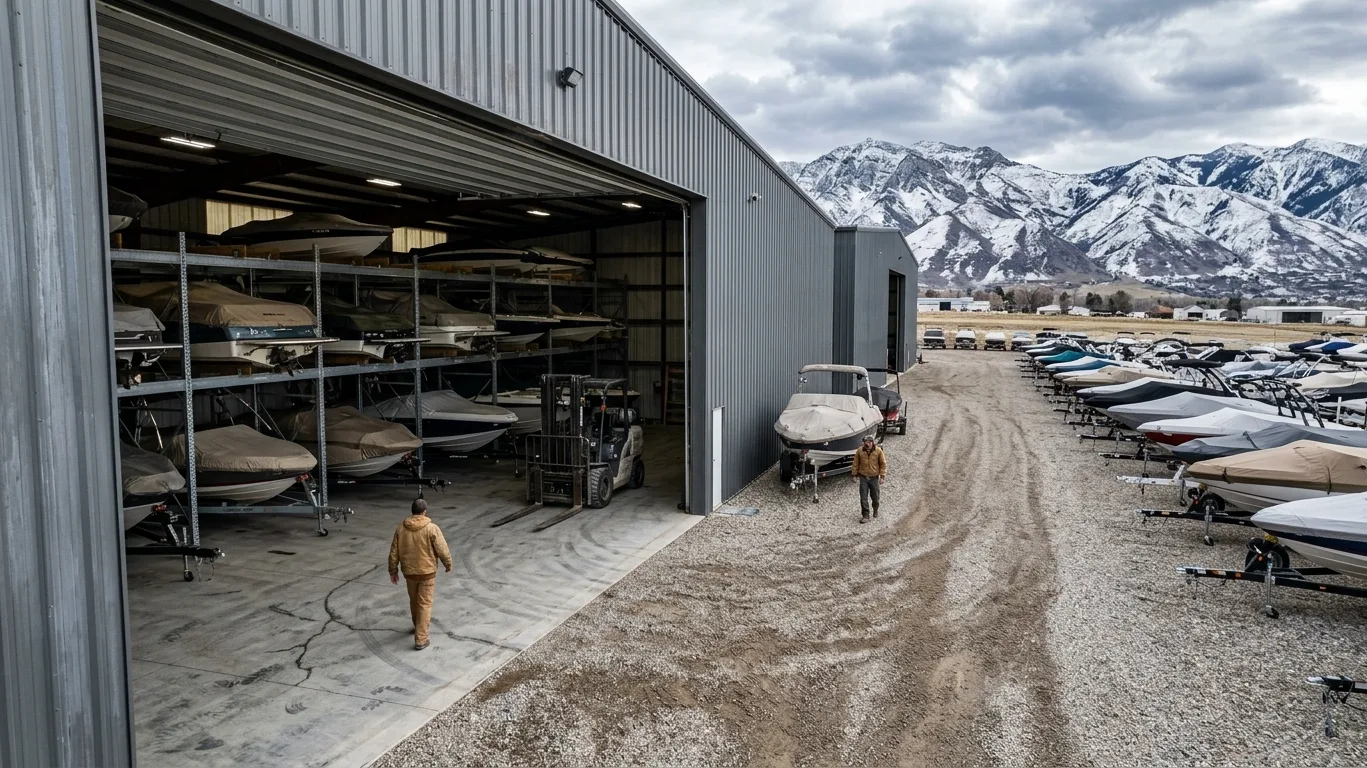
In an indoor storage building or other suitable facility, the hull, upholstery, electronics and exterior parts are protected from rain, snow and direct sunlight.
Indoor storage also limits large temperature swings and reduces exposure to wind.
For the upholstery, this is a real plus. The risks of condensation and mildew can be better controlled in a dry, properly ventilated environment.
Indoor storage also has a practical benefit: the boat usually stays cleaner and can be easier to check on during the winter.
Does indoor winter storage fully protect the boat?
No.
This is an important nuance.
An indoor storage building protects from the weather, but it doesn’t automatically create a dry, stable environment. A poorly ventilated building can retain a lot of moisture, especially during cold spells.
The quality of the storage therefore also depends on the building itself: ventilation, ambient humidity, temperature, air circulation and how the boat is parked.
Good indoor winter storage therefore combines physical protection and moisture control.
What are the advantages of outdoor winter storage?
Outdoor storage has above all a practical advantage: it is generally easier to arrange and can cost less.
For a boat that spends several months on a trailer, it can also make perfect sense to leave it outside, provided it is properly prepared.
However, a boat stored outside should be considered exposed to several stresses:
- rain and snow;
- frost;
- wind;
- moisture;
- temperature swings;
- UV radiation;
- dirt and debris.
Preparation must therefore be more thorough on the parts that are directly exposed.
How do you protect a boat stored outside for the winter?
The first line of protection is a cover suited to the boat.
It must effectively protect the hull and equipment without creating a permanent pocket of moisture.
A tarp simply thrown over the boat is not necessarily a good solution. It can flap in the wind, rub against the finish or the gelcoat and, above all, trap water through condensation.
A cover made for the boat’s model, or a properly installed cover, protects the surfaces better while keeping enough ventilation.
The tie-down points also deserve particular attention: effective protection must hold up to a whole winter of weather without slackening or constantly rubbing against the hull.
Which winter storage should you choose for a powerboat?
The engine alone does not determine the choice between indoors and outdoors, but it strongly influences the preparation needed.
On an outboard, you need to take into account the position of the engine, water drainage and the steps the manufacturer specifies for storage.
On an inboard, protecting the engine and its various systems is even more important. The cooling system, fuel, fluids, battery and transmission must be prepared according to the boat’s configuration.
So a boat stored outside is not simply “covered and left there.”
In both cases, the quality of the mechanical winterization remains the priority over the simple choice of storage location.
Is cold dangerous for a boat stored outside?
Cold in itself is not necessarily a problem for a correctly winterized boat.
The risk arises when water stays trapped in a system, a piece of equipment or a part of the engine that can freeze.
This is one of the main reasons why preparing the engine is essential before a freezing period.
On a powerboat, you need to follow the storage procedure specified for the engine in question: draining or protecting the systems according to their design, checking fluids, preparing the fuel and the battery, among other steps.
The exact procedure varies from engine to engine. The manufacturer’s manual must therefore take precedence over any one-size-fits-all method found online.
Should the boat come out of the water for the winter?
In many situations, yes, especially when the boat can be kept in dry storage.
Storage on land makes it easier to inspect the hull, limits its permanent exposure to water and makes some maintenance tasks easier to carry out.
For a boat used on Lake Annecy, storing it on land over the winter also makes it possible to prepare calmly for the next season without leaving the hull in the water for several months.
But here again, dry storage is not an absolute guarantee: the boat must be properly supported and protected against the stresses of wind, the weight of snow or accumulating water.
Why is moisture a problem during winter storage?
Because it can affect virtually every part of the boat.
Upholstery can develop mildew, metal parts can oxidize, electrical connectors can corrode and some materials can hold a lot of moisture for several weeks.
In a closed cabin, condensation can make the problem worse.
That’s why a boat stored indoors for the winter must also be properly ventilated.
Outdoor storage under a breathable, well-fitted cover can sometimes provide a better environment than a closed but damp and poorly ventilated building.
Should you remove the cushions for outdoor winter storage?
When storage conditions are damp, it’s a sensible precaution.
Cushions and mattresses can hold moisture, and the surfaces underneath are often poorly ventilated.
Removing them lets the air circulate better and, if needed, allows them to be stored somewhere dry.
However, avoid sealing them in airtight bags if they are not completely dry.
For a boat that stays outside all winter, this precaution is especially worthwhile.
Does a boat stored outside deteriorate faster?
It is more exposed to certain aging factors, but much depends on the quality of the protection.
UV in particular can affect exterior materials, fabrics, some plastics and finished surfaces. Wind can also put a poorly installed cover to the test.
Finally, rain and freeze cycles can make some existing problems worse.
For this reason, a boat stored outside needs suitable protection and periodic checks.
A properly installed cover and a boat prepared before winter can greatly reduce these risks.
How do you choose between indoors and outdoors?
There is no single answer that fits every owner.
| Situation | Usually the most suitable solution |
|---|---|
| Recent, well-equipped boat | Indoors or outdoors depending on the quality of the protection |
| Boat with a cabin and moisture-sensitive upholstery | Indoors is an advantage if the building is dry and ventilated |
| Boat on a trailer | Outdoors is possible with a suitable cover |
| Boat stored for several months in a cold region | Indoors preferable if available |
| Outdoor storage without protection | Avoid |
| Very damp, poorly ventilated storage building | Not necessarily better than well-protected outdoor storage |
So the most important criterion is not just “inside or outside,” but under what conditions will the boat spend the winter?
What is the best choice for a boat used on Lake Annecy?
On Lake Annecy, several solutions are possible.
A boat that is regularly taken out of the water can spend the winter on land, under a suitable cover or in a storage facility.
For owners who want to minimize exposure to the weather and make it easier to keep an eye on the boat, indoor storage has an obvious advantage.
In particular, it makes it easier to work on the boat during the winter and protects the upholstery, equipment and exterior finishes.
But outdoor storage remains an option if the boat is properly prepared and protected.
What matters most is matching the winterization to the length of storage and the boat’s configuration.
What should you check before outdoor winter storage?
What are the advantages of professional boat winterization?
The main benefit is that winterization becomes much more than just a place to park the boat.
Professional winterization can include engine preparation, protecting the boat, checking the battery, monitoring moisture and the maintenance work needed before recommissioning.
This is especially worthwhile when the owner doesn’t have a suitable space or doesn’t want to handle the various steps themselves.
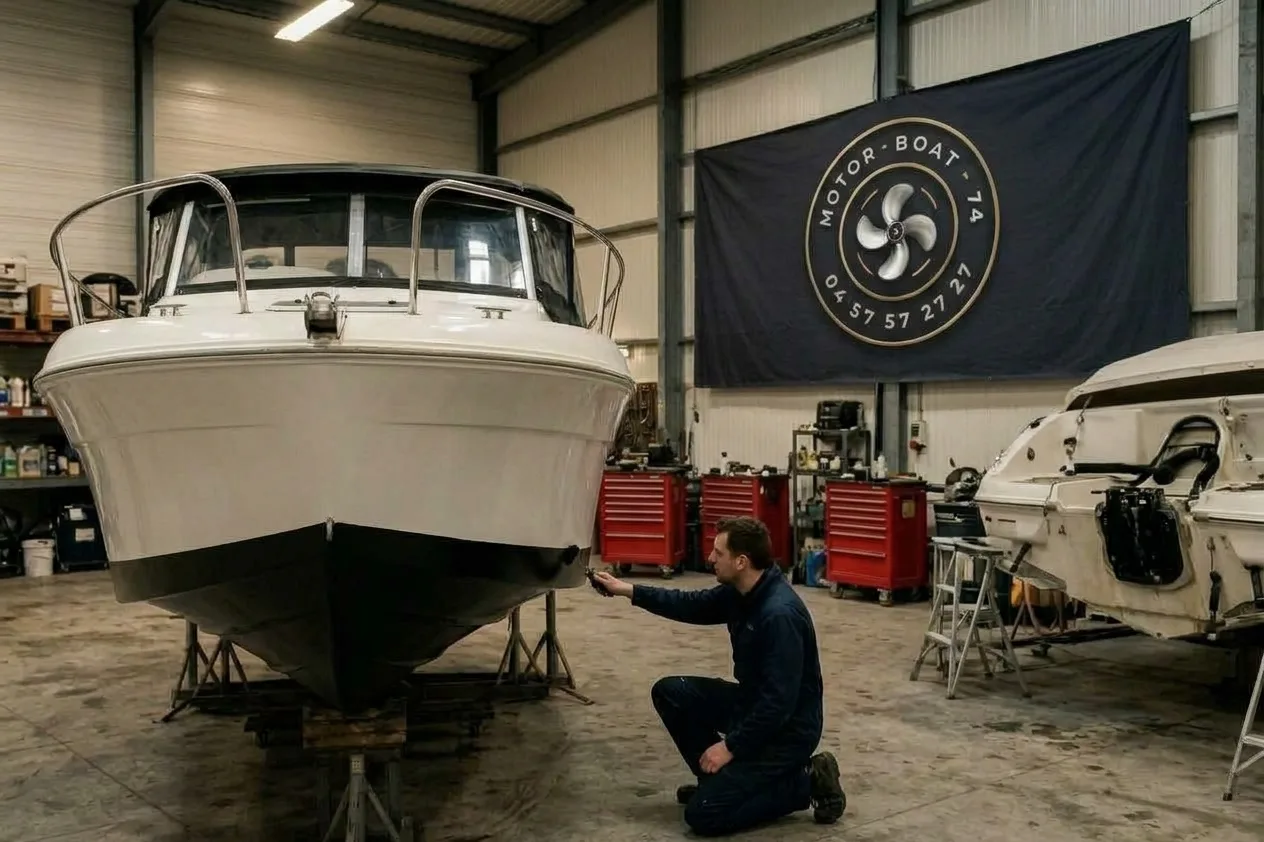
In Annecy, Motor Boat 74 has a storage facility dedicated to winter boat storage and can help owners prepare their boats before the winter period.
How do you prepare your boat, whatever the storage location?
Whether the boat spends the winter in indoor storage or outside, some steps are essential.
- Clean and dry the boat before storage.
- Prepare the engine according to the manufacturer’s recommendations.
- Check the relevant levels and fluids.
- Prepare the battery.
- Limit power draw.
- Protect the upholstery and moisture-sensitive equipment.
- Check the drains.
- Inspect the hull and exterior parts.
- Plan protection suited to the storage location.
This preparation matters more than simply choosing indoor storage over an outdoor spot.
So, indoor or outdoor winter boat storage: which is better?
If you have access to dry, ventilated indoor boat storage, indoor winter storage generally remains the most protective solution.
It limits exposure to the weather, better protects equipment and makes work during the winter easier.
But properly done outdoor winter storage can be perfectly suitable. The priority is then to protect the boat against rain, frost, UV and moisture while keeping good ventilation.
In short, a boat that is well prepared and properly protected outdoors is better than a poorly ventilated boat in a damp storage building.
If you would rather not handle all these steps yourself, Motor Boat 74 offers boat storage & winterization in Annecy, with storage and preparation of your boat for the winter.
FAQ
Is it better to store a boat indoors for the winter?
Yes, if the building is dry, properly ventilated and suited to boat storage. Indoor winter storage limits exposure to rain, snow, frost and UV in particular. It does not, however, remove the need to keep an eye on moisture and ventilation.
Can a boat be left outside all winter?
Yes, provided it is properly prepared. The engine must be winterized according to the manufacturer’s recommendations and the boat must be protected by a suitable cover that is properly installed and well ventilated.
Is a tarp enough to protect a boat outside?
Not necessarily. A poorly installed tarp can trap moisture, rub against the hull or be damaged by the wind. A cover suited to the boat and the storage conditions is preferable.
Does the boat need to come out of the water for the winter?
When possible, storage on land generally makes it easier to inspect and maintain the hull. The decision does, however, depend on the type of boat, where it is stored and local conditions.
Is a damp indoor storage building better than outdoor storage?
Not necessarily. A damp, poorly ventilated building can encourage condensation, mildew and corrosion. Properly covered and ventilated outdoor storage can sometimes offer better conditions.
Should you remove the upholstery for the winter?
When the boat is stored in a damp environment, removing the cushions and keeping them somewhere dry can reduce the risk of mildew. In any case, the upholstery must be completely dry before storage.