Spring is here, the good weather is back and the urge to put the boat back in the water is immediate. Yet after several months of storage, the first thing to do isn’t turning the key.
An engine can start perfectly well after the winter while having a leak, a cooling problem, a tired battery or an issue with the lower unit or transmission.
Getting the engine back into service is precisely what keeps a small problem from turning into a breakdown out on the lake.
Here’s a step-by-step method to de-winterize a boat engine properly, from the first check to the first outing.
If you’d rather leave this preparation to a professional, Motor Boat 74 offers a boat winterization and preparation service in Annecy.
Where should you start after the winter?
Before touching the engine, take a few minutes to look over the boat as a whole.
This step is often overlooked. Yet after several months of storage, you may find a dead battery, a loose hose, a trace of fluid under the engine or a damaged cable.
So start by opening the engine compartment and take the time to look for:
- any oil, water, fuel or coolant;
- the condition of the accessible hoses and clamps;
- electrical cables and connections;
- signs of corrosion;
- the general condition of the engine compartment;
- any rodents or damage caused during storage.
On an inboard, this inspection is especially worthwhile: the engine and part of its systems are enclosed in the boat, and some issues can be hard to spot once the engine is running.
Should you start by reconnecting the battery?
Yes, but not without checking it.
A battery that has sat unused for several months may have lost part of its charge or capacity. Simply putting it back in place isn’t enough to tell whether it’s ready for the season.
Check its condition, its charge and the state of the connections. The terminals should be clean and properly tightened.
A tired battery sometimes gives itself away on the very first crank: the engine turns over slowly, starting is labored or the electrical gauges behave unusually.
Mercury in particular recommends checking the battery’s condition and charge when recommissioning in the spring, and points out that a battery left discharged for a long time can suffer sulfation and permanently lose capacity.
See Mercury’s battery recommendations
Which fluids should you check in the spring?
Checking the fluids is one of the key steps before the first start.
Depending on the engine, you will check in particular:
- the engine oil level and condition;
- the coolant on engines with a closed cooling system;
- the lower unit gear oil on an outboard or sterndrive;
- the transmission oil or lubricant on the relevant configurations;
- any other fluids specified by the manufacturer.
Above all, look at the condition of the fluid, not just its level.
For example, lower unit gear oil that looks milky or “mayonnaise-like” can indicate water intrusion. That’s not a detail to ignore before launching: you need to find where the water is getting in and check the seals.
Mercury in particular recommends this check when preparing boats in the spring.
See Mercury’s spring commissioning checklist
What should you check on the cooling system?
This is probably the point that calls for the most attention at the first start.
A marine engine produces a lot of heat and depends on its cooling system to run normally. After winterization, however, some components may have been drained, removed or set up for storage.
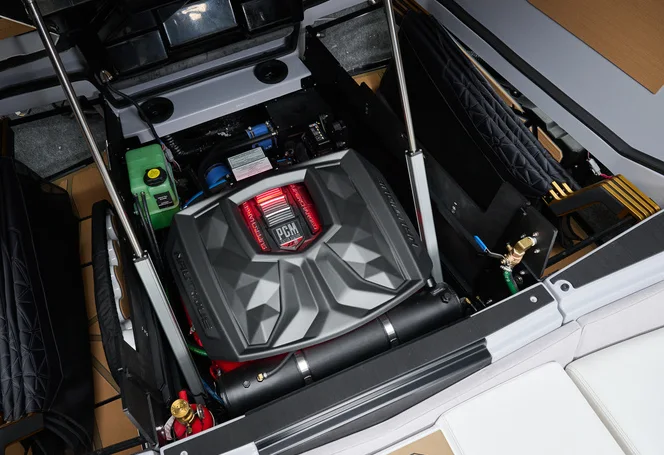
Before starting, make sure the system has been returned to its normal configuration and that the procedures specified by the manufacturer have been carried out.
On an inboard, the setup can vary quite a bit from one engine to another. Some use raw-water cooling, others have a closed cooling system with a heat exchanger, and some configurations combine the two.
So identify the exact system before doing any work.
On an outboard, the rule is just as important: the engine must never run without a suitable water supply. Out of the water, use the device specified by the manufacturer to keep it cooled.
Mercury notes in particular that an outboard should not be started dry, as the water pump can be damaged quickly.
See Mercury’s recommendations on starting out of the water
What about fuel after several months of storage?
Fuel is another point not to overlook.
If the tank and fuel system were properly prepared before the winter, getting back into service is usually simpler. On the other hand, old or contaminated fuel can cause hard starting, rough running or fuel delivery problems.
Before making repeated attempts to start, check that the fuel is fit for recommissioning and that the manufacturer’s storage recommendations were followed.
If the engine won’t start after the winter, it’s better to look for the cause than to keep trying: the battery, fuel supply, ignition, an electronic safety system or another system may be involved.
What should you check on the lower unit, propeller or transmission?
Getting the engine back into service isn’t limited to the engine block.
On an outboard, take a close look at the propeller and the lower unit. A bent blade, an impact or fishing line wrapped around the shaft can have far bigger consequences than it seems.
Line or rope caught around the shaft can damage a seal and then let water into the gearcase.
On an inboard, the checks depend on the transmission: straight shaft, V-drive, direct drive or another system. So the inspection points aren’t the same.
It’s also the right time to check that components removed during winterization have been properly reinstalled and that lubricant levels match the manufacturer’s specifications.
How should you handle the first start-up?
Once the checks are done, it’s finally time to start the engine.
But here again, the goal isn’t simply to see whether the engine “fires up.”
At the first start, watch closely:
- how quickly the engine cranks;
- the idle speed;
- warning lights and any alarms;
- oil pressure, when displayed;
- engine temperature;
- cooling system operation;
- any leaks;
- unusual noises or vibrations.
On an outboard, check in particular that the cooling system is working properly. On an inboard, also keep an eye on the various systems accessible in the engine compartment.
An engine that starts but whose temperature rises abnormally, triggers an alarm or shows a leak must be shut down and inspected.
Can you head out on the water right after the first start?
It’s best not to.
The first start should be treated as a recommissioning test, not as the beginning of the first outing of the year.
After checking that the engine runs properly, gradually test the controls and related equipment: steering, throttle, shifter, trim if fitted, bilge pump and gauges.
The first run on the water can then be done in conditions where you can easily react if something goes wrong. There’s no need to set off right away on a long crossing of the lake with an engine that has just spent several months sitting idle.
Is getting an outboard back into service different from an inboard?
Yes, even though the general logic is the same.
| Check | Outboard | Inboard |
|---|---|---|
| Battery | Check charge and connections | Check charge and connections |
| Engine oil | Check according to engine specifications | Check according to engine specifications |
| Cooling | Water supply essential out of the water | Check systems according to the setup |
| Lubrication | Engine oil and lower unit gear oil | Engine oil and transmission depending on configuration |
| Propulsion | Propeller, shaft, lower unit | Transmission, shaft, propeller depending on configuration |
| Engine compartment | Visual check | Especially important check |
An outboard is generally more accessible. On an inboard, you sometimes have to check several systems in a tighter space. That doesn’t mean one type of engine is necessarily more reliable than the other: it simply means the recommissioning procedure isn’t interchangeable.
What should you do if the engine won’t start after the winter?
Avoid making repeated attempts.
An engine that won’t start can have many causes, and persisting generally won’t solve them.
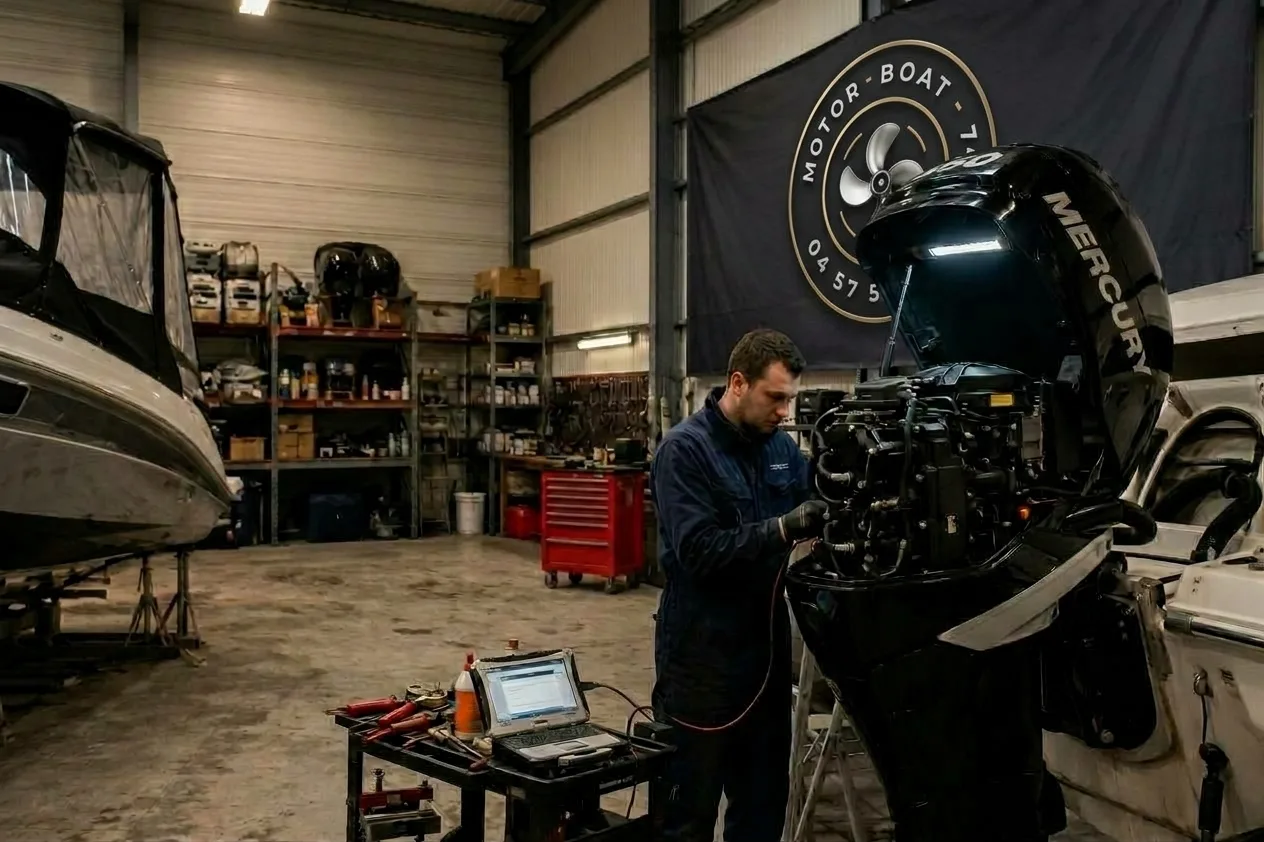
Start with the simple checks: battery, connections, fuel supply, kill switch and any alarms. If the problem persists, move on to a diagnosis suited to the engine.
On modern engines, electronic systems can also log faults that require a specific diagnostic tool.
Likewise, if the engine starts but overheats, triggers an alarm or shows a leak, shut it down immediately.
Should you have a professional get your engine back into service?
Not necessarily for every boat.
An owner who knows their engine well, has the manufacturer’s documentation and knows exactly how the boat was winterized can carry out some of the checks themselves.
However, bringing in a professional becomes especially worthwhile when:
- you don’t know exactly what was done during winterization;
- the boat has been laid up for several years;
- the engine has a leak or a problem;
- the lower unit gear oil or transmission oil looks unusual;
- the engine overheats or triggers an alarm;
- the battery no longer holds a charge;
- the engine or transmission is complex;
- you want the start-of-season service done at the same time.
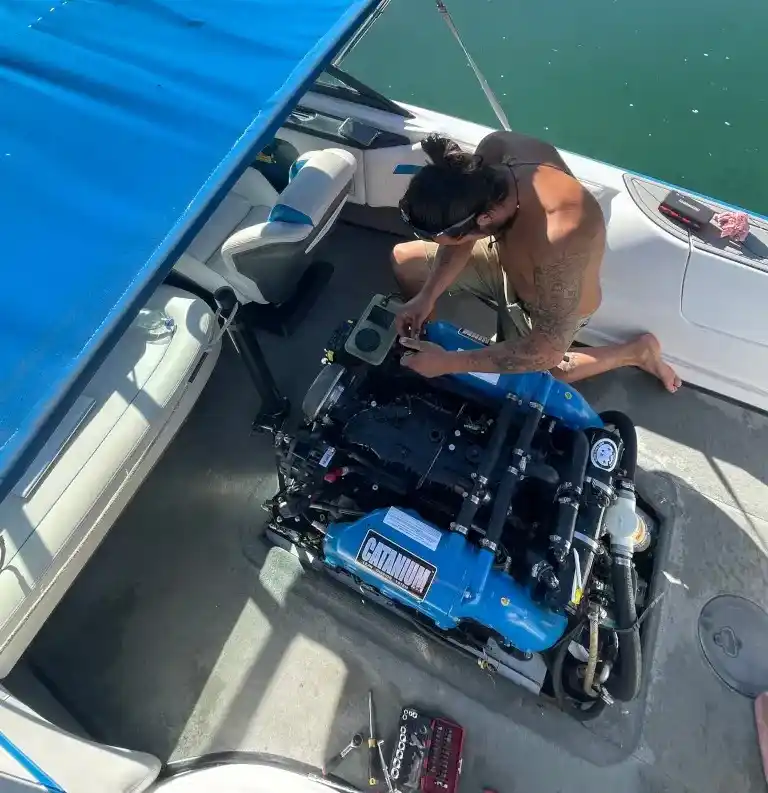
The advantage of a professional is that they don’t stop at starting the engine, but check that everything is truly ready for the season.
Motor Boat 74 helps owners in Annecy prepare and service their boats after the winter storage period.
The spring commissioning checklist
So, how do you properly de-winterize your boat engine in the spring?
In principle, the best recommissioning is actually quite simple: leave nothing to chance before starting.
You begin by inspecting the boat, then check the battery, fluids, cooling, fuel and propulsion. Only then comes the first start, with close monitoring of temperature, pressure, alarms and any leaks.
Finally, the first outing should gradually confirm that the boat is running normally.
The key point is not to apply a one-size-fits-all recipe. An outboard, an inboard with raw-water cooling and an inboard with a closed cooling system are not returned to service in exactly the same way. The manufacturer’s procedure and the boat’s actual configuration must always come first.
If you’d like your boat checked and prepared before the new season, Motor Boat 74 offers its boat winterization and preparation service in Annecy.
FAQ
Can you simply start your boat after the winter?
It’s not recommended. After several months of inactivity, first check the battery, fluids, cooling, fuel and propulsion components. The first start should then be monitored to detect any leak, alarm, overheating or other problem.
Can you start an outboard on its trailer?
Yes, but only under the conditions specified by the manufacturer and with a suitable water supply. An outboard must never run dry: the water pump can be damaged quickly.
How can you tell if water got into the lower unit over the winter?
Checking the lower unit gear oil gives a first clue. Milky or emulsified oil can indicate water and should prompt you to look for a leak or seal problem before launching.
Should you change the engine oil in the spring?
Not necessarily. It depends on the engine’s maintenance schedule and what was done during winterization. If an oil change is scheduled, or was due and wasn’t done, spring can be the right time to take care of it.
How long should you run the engine before heading out?
There’s no universal duration. The goal of the first run is to check that the engine reaches normal operation, that the cooling works and that no leak, alarm or other problem appears. Follow the recommendations specific to the engine.
What should you do if the engine overheats as soon as it’s back in service?
Shut it down and find the cause before continuing. A cooling problem can have several origins depending on the engine: water supply, pump, blocked circuit, coolant level or another fault. Never keep running an engine that is overheating.