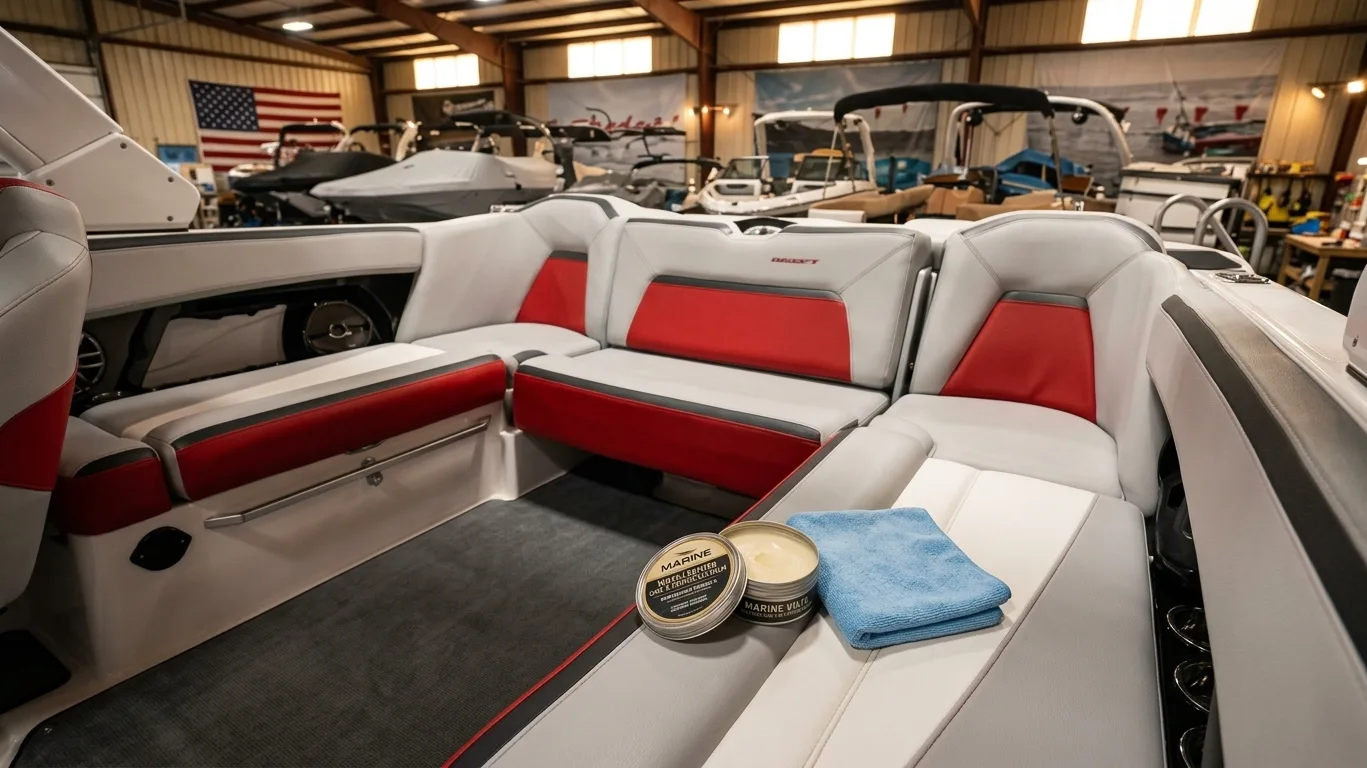
To protect the upholstery, start by storing the leather clean and completely dry, promote regular airflow and avoid creating a damp, enclosed environment.
At the end of winter, it’s not unusual to find a boat that smells stale. And sometimes the first signs show up right on the upholstery: small black spots, water stains, a sticky surface or leather that seems to have lost its original look.
This problem isn’t necessarily caused by a defect in the leather.
In many cases, it’s simply the result of several weeks or months spent in a damp, poorly ventilated environment subject to large temperature swings.
The good news is that most of these problems can be largely prevented with a few precautions taken before winter storage.
Why does boat upholstery get moldy over the winter?
Mold needs three things to grow: moisture, a favorable temperature and a surface it can grow on.
In a boat, conditions can quickly become favorable. The air inside is often humid, temperatures swing sharply between day and night, and the upholstery offers plenty of surfaces that can hold moisture.
Condensation is especially significant when humid air meets a cold surface.
A boat closed up for several weeks can therefore build up moisture without any significant water getting in.
Upholstery that is completely dry when the boat goes into storage is much easier to protect than upholstery that is already damp.
Is leather particularly sensitive to moisture?
Yes, but you need to distinguish genuine leather from the synthetic coverings used on some marine upholstery.
Leather is a natural material that can absorb and release a certain amount of moisture. Repeated exposure to a humid environment can change its appearance and encourage mold to form on its surface.
Seams, folds and the areas between cushions need particular attention: air circulates less easily there and moisture can linger longer.
You also need to consider the padding. Even if the leather surface looks dry, the inside of a cushion may still be holding moisture.
That’s why drying only the surface isn’t always enough.
Should you clean the upholstery before winter storage?
Yes.
Cleaning before storage is a simple step, but it makes a real difference.
The upholstery should be cleared of sweat, salt, dust, sunscreen, food and other dirt that has built up over the season.
These residues can hold moisture and speed up the deterioration of the covering.
For leather upholstery, use a product suited to the type of leather and follow the manufacturer’s recommendations. Avoid harsh household products, solvents or degreasers not intended for leather.
After cleaning, let the upholstery dry completely before closing up the boat for the winter.
Should you remove the cushions during winter storage?
When possible, it’s often an excellent precaution.
Removing the cushions helps ventilate the cabin and keeps surfaces from staying in contact with each other for months.
In a boat stored somewhere dry, the cushions can stay on board in good conditions. However, if the boat is exposed to high humidity, storing them in a dry, ventilated place may be better.
Above all, avoid sealing them in airtight plastic bags while they still contain the slightest moisture.
Storage should protect against moisture without stopping air from circulating.
Does a cover really protect upholstery from moisture?
Yes, but a cover used the wrong way can do exactly the opposite.
A waterproof cover placed directly over damp upholstery can trap condensation beneath the fabric or covering.
For winter storage, there are therefore two goals: protecting the upholstery from outside water and allowing the moisture inside to escape.
A breathable cover designed for boat storage is generally a better choice than a fully waterproof tarp pressed against the cushions.
How can you limit condensation in the cabin?
Ventilation is one of the best ways to limit moisture problems over the winter.
When the boat’s layout and storage conditions allow, the vents provided by the manufacturer should remain functional.
Avoid automatically blocking vent grilles or openings to “keep the boat warm.” The boat doesn’t need to be heated like a home during several months of storage.
What matters most is allowing moisture to circulate and escape.
On some boats, additional solutions can be used:
- vents or passive ventilation devices;
- suitable moisture absorbers;
- an electric dehumidifier when the storage setup allows it;
- opening the cabin regularly when conditions are favorable.
The choice depends heavily on where the boat is stored and the type of boat.
Do moisture absorbers work on a boat?
They can be useful, but they don’t replace good ventilation.
A moisture absorber can collect part of the moisture in a closed cabin. It’s a simple solution, especially when the boat has no power supply over the winter.
However, you need to choose a product sized for the volume to be treated and check the collection container regularly.
A full absorber left unchecked for several months obviously isn’t doing much anymore.
And above all, it won’t fix a water leak, seepage or upholstery that was stored while still damp.
How do you protect seams and hard-to-ventilate areas?
Seams are often the first areas to watch.
Dust and moisture can build up there, while the gaps between cushions get little airflow.
Before winter storage, pay particular attention to:
- seams;
- joints between cushions;
- the underside of seats;
- backrests;
- areas close to the hull sides;
- storage lockers containing upholstery;
- spots under mattresses or cushions.
Upholstery resting directly against a cold hull side can also encourage condensation. When possible, leaving a small gap between the cushion and the hull side improves airflow.
Can you use oil or grease to protect leather?
It’s best to avoid products not specifically designed for marine leather.
An oil or grease that is too rich can change the look of the surface, attract dust or make later repairs more complicated.
The right product depends on the type of leather and its finish. Some modern upholstery in particular has surface treatments that don’t react like traditional leather.
The product recommended by the covering’s manufacturer should therefore take priority.
What should you do if mold has already appeared?
Act quickly, but without scrubbing the surface aggressively.
Start by identifying the cause: excessive condensation, seepage, damp upholstery, poor ventilation or unsuitable storage.
Then clean the surface with a product compatible with the covering in question. Treating genuine leather isn’t necessarily the same as treating faux leather or marine vinyl.
After cleaning, drying is essential.
If the mold comes back quickly, don’t just clean it again. A recurrence usually means the moisture problem hasn’t been solved.
How can you tell whether the problem is condensation or a leak?
This is an important question, because the two problems aren’t treated the same way.
Widespread condensation often affects several surfaces: windows, cold walls, upholstery, the underside of cushions or metal parts.
A leak is usually more localized. You may find a damp mark near a window, a porthole, a hatch, a through-hull fitting or a deck joint.
If one specific area stays damp while the rest of the cabin is dry, look for where water is getting in rather than simply adding more moisture absorber.
Upholstery that keeps getting moldy in the same spot calls for an inspection of the boat itself.
Should upholstery be heated over the winter?
Not necessarily.
Constant heating is generally not the first answer to a moisture problem. It can even be counterproductive if the humid air isn’t vented.
For a properly winterized boat, the priority is rather to keep water out, promote ventilation and check the condition of the cabin regularly.
In some covered, equipped storage facilities, a dehumidifier can be used more effectively than constant heating.
In any case, the electrical installation must be suitable for running the equipment over long periods.
How do you prepare boat upholstery for winter storage?
Should you keep an eye on the upholstery all winter?
Yes, when possible.
A check-up visit in the middle of winter can save you from discovering months later that condensation has settled into the cabin.
Take the opportunity to look at the cushions, walls, windows and hard-to-reach areas. Also check the moisture absorbers if you use them.
This monitoring is particularly worthwhile after a very wet spell or when temperatures have swung sharply.
A few minutes of checking can spare you a much bigger cleanup in the spring.
What if the boat is kept in indoor storage?
Indoor boat storage effectively protects the boat from rain and snow, but it doesn’t automatically guarantee a dry environment.
Depending on the building, the air can remain very humid and temperature swings can cause condensation inside the boat.
Covered storage should therefore be seen as protection from the weather, not as a guarantee against moisture.
Ventilating the boat remains important, even when it is parked under cover.
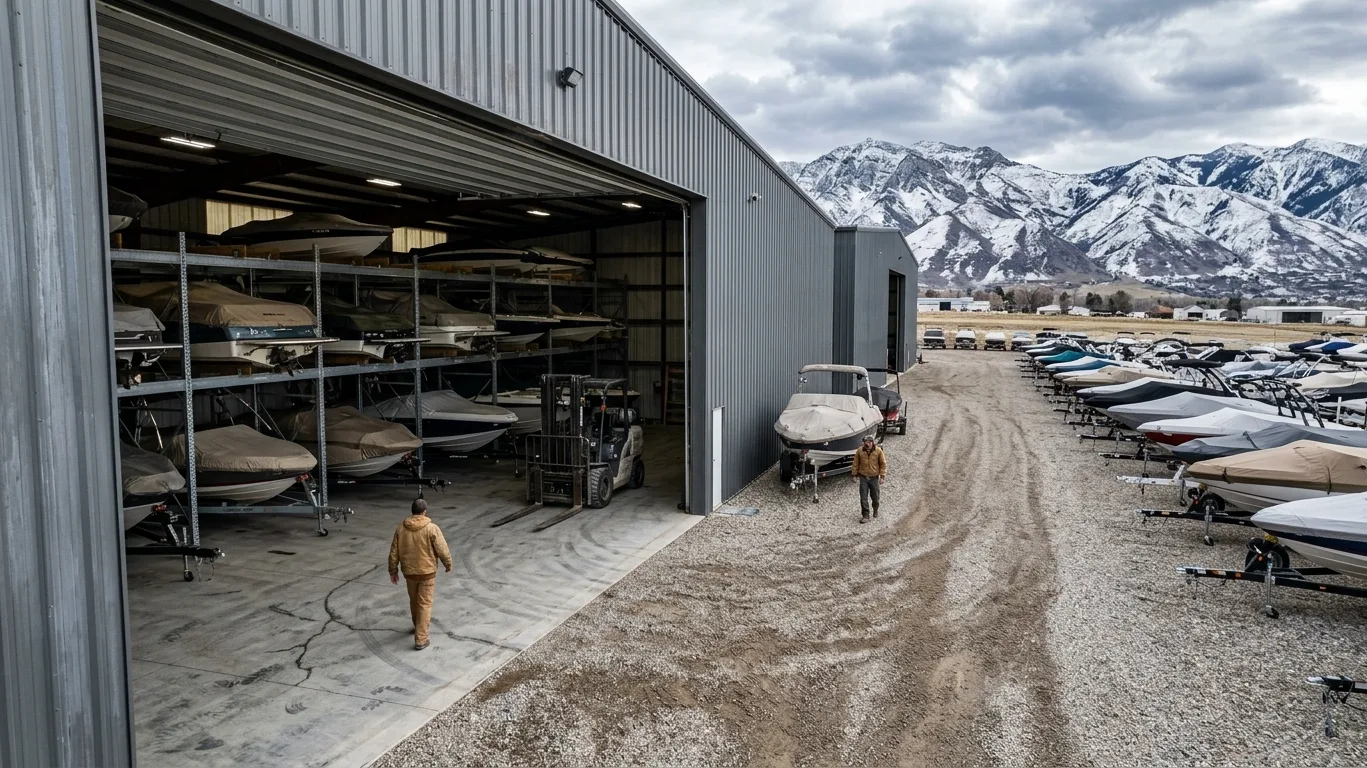
At Motor Boat 74, boats can be kept in a dedicated storage area during the winter. To properly prepare a boat for several months of storage, take a look at our boat winterization service in Annecy.
The anti-mold checklist for upholstery
So, how do you protect leather upholstery over the winter?
The best protection against mold starts before you even close up the boat.
Clean the upholstery, dry it completely, avoid sealing the cushions in airtight covers and let the air circulate. Then adapt your moisture management to the storage location: natural ventilation, an absorber or a dehumidifier depending on the conditions.
And above all, don’t just treat the mold spots when they appear. If they keep coming back, the moisture problem is usually still there.
For a boat winterized in good conditions, a few simple checks during the cold season often mean finding clean, healthy upholstery in the spring.
If you’d like to prepare your boat for winter storage in Annecy, Motor Boat 74 offers a boat winterization and preparation service.
FAQ
Why does my upholstery get moldy over the winter?
The cause is usually too much moisture combined with insufficient ventilation. Condensation, upholstery that is still damp or a leak can create conditions that favor mold growth.
Should you remove the cushions from the boat over the winter?
It isn’t always necessary, but it’s often a good precaution. Removing them improves airflow and lets you store them somewhere drier when the boat itself is damp.
Can you leave a waterproof cover on leather upholstery?
A fully airtight cover can trap moisture. For long-term storage, a suitable and sufficiently breathable cover is generally better, provided the upholstery is completely dry before it is covered.
Is a moisture absorber enough to prevent mold?
It can help reduce ambient humidity, but it doesn’t replace ventilation and won’t fix a water leak. It also needs to be properly sized and checked over the winter.
How do you remove mold from boat leather?
Use a product compatible with the covering and avoid harsh products not intended for leather. Above all, find the cause of the moisture: if it isn’t fixed, the mold is likely to come back.
Does cold stop mold from growing?
Cold generally slows its growth, but it doesn’t eliminate the problem. When conditions become favorable again, upholstery that stayed damp can quickly show signs of mold.