Boat Winterization 12 min read Published October 6, 2025Updated October 23, 2026 The Motor Boat 74 team
An engine whose cooling water freezes can crack overnight. A battery left on board drains and will not come back to life in the spring. Damp upholstery under a poorly ventilated cover grows mold within a few weeks. Proper winterization prevents these three failures, which are the most common and the most expensive when the boat goes back in the water. The steps below apply to all boats: outboard, inboard, sailboat or RIB. The points specific to each type are grouped further down, and the inboard, the most technical case, has its own guide. ## Preparing the boat for winterization Before you store your boat for the winter, it is essential to prepare it properly. This step keeps the hull, the engine and all the equipment in perfect condition, and makes launching easier in the spring. Here are the key points to follow. ### 1. Cleaning the hull and deck A thorough cleaning is essential to protect your boat from corrosion and deposits. Rinse the hull and deck carefully with fresh water to remove salt, algae and limescale. Use a dedicated soap suited to fiberglass, aluminum or wooden hulls so you do not damage the gelcoat or paint. Take this opportunity to inspect the surface: cracks, chips or signs of osmotic blistering should be repaired before winter. If your boat has bottom paint (antifouling), check its condition and apply a new coat if needed. Do not forget the interior: seats, sun pads and carpets should be cleaned with fresh water before applying a suitable protectant, which prevents mold and cracking during the damp months. If a seat is worn or faded, winter is the right time to bring it to our boat upholstery workshop, since reupholstering is faster in the off-season. ### 2. Engine service and oil change The engine is the part most vulnerable to winter damage. Start by changing the oil and replacing the filters so that used oil does not damage internal components. Then protect the cooling system with antifreeze suited to your engine type: outboard or inboard.
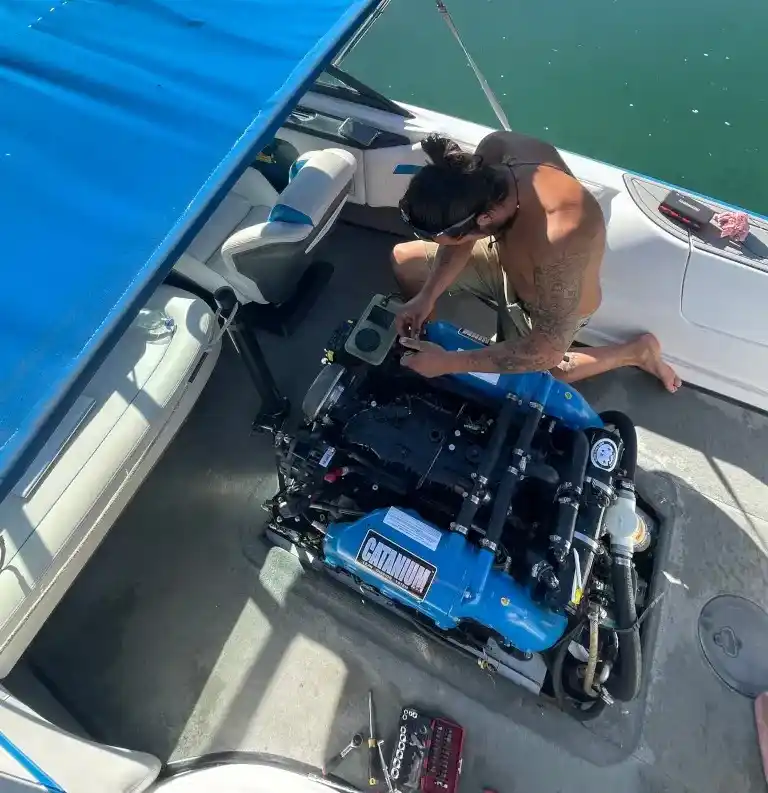
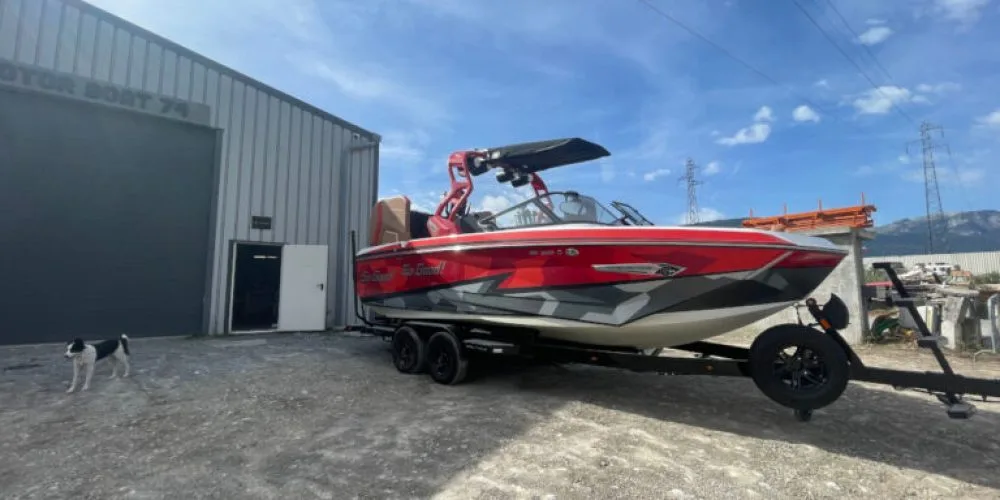
An inboard engine being prepared by the Motor Boat 74 workshop. We also recommend adding a fuel stabilizer to prevent oxidation and deposits from forming in the fuel tank. Check the spark plugs, propeller, anodes and fasteners. Grease the shafts and moving parts to prevent corrosion and seizing. The winter layup is also the ideal time to deal with whatever was put off during the season. A suspicious noise, overheating or a vibration spotted in the fall can be fixed without pressure: scheduling an engine and hull service before storage saves you the wait and the downtime at the height of spring, when workshops are fully booked. Quick technical note: sacrificial anodes are metal parts that corrode in place of sensitive components, protecting the boat's structure from oxidation. ### 3. Batteries and electronics Batteries and electronic equipment are particularly vulnerable to humidity and low temperatures. Remove the batteries and store them in a dry, temperate place, ideally on a float charger to maintain their charge. Disconnect all electronic instruments and navigation systems to protect them from moisture. Take the opportunity to check the cables and connectors: clean off any corrosion and apply a protective spray for electrical contacts if needed. ### 4. Lubrication and additional checks Finally, make sure all moving parts and auxiliary systems are working properly. Grease hinges, pulleys and shafts, and check that the bilge pumps and water systems work properly. Also inspect hoses and lines for cracks or wear. Noting any issue at this stage lets you plan repairs before launch. ### Summary table | Step | Actions | Technical tips | | --- | --- | --- | | Cleaning the hull and deck | Rinse with fresh water, wash with a suitable soap | Check gelcoat and paint, repair cracks, renew bottom paint | | Engine service | Oil change, filters, cooling system protection | Suitable antifreeze, stabilizer, check propeller, spark plugs, anodes | | Batteries and electronics | Remove and keep on a float charger, disconnect | Store dry, protect cables (anti-corrosion spray) | | Lubrication | Grease hinges, pulleys, shafts; check bilge pumps | Inspect hoses and lines, note any issues | ## Choosing a winterization method The right method depends on the size of your boat, your budget and the level of protection you want. Each option has advantages and constraints worth knowing. ### Indoor boat storage Indoor winter boat storage offers maximum protection against bad weather, freezing and humidity. It is the safest option, especially for large or high-value boats. That is exactly what our boat winterization service in Annecy offers: a secure indoor storage facility, engine and hull preparation and, if needed, boat transport from your jetty to the workshop. In front of the Motor Boat 74 winter boat storage building. - Advantages: boat sheltered from snow, wind and freezing; easier maintenance on dry land; enhanced security (controlled access, video surveillance). - Things to watch: higher budget than outdoor storage; availability sometimes limited depending on the region. ### Outdoor winter storage For smaller boats or when indoor space is not available, outdoor winter storage remains an effective option if it is well prepared. - Tips: a breathable cover, securely fastened; support the boat on blocks or a suitable trailer; protect the engine and sensitive equipment. - Things to watch: regular checks are needed; humidity and temperature swings speed up wear if the cover is poorly fitted. ### Dry storage or storage on a trailer Dry storage, on a trailer or on blocks, is particularly well suited to small boats. It provides easy access for maintenance and limits contact with water. - Advantages: effective protection against freezing and humidity; simpler maintenance; precise support possible. - Things to watch: requires a secure, level location; protection from rain and snow is still needed. ### Comparing the methods | Method | Protection | Budget | Strengths | | --- | --- | --- | --- | | Indoor boat storage | Maximum | High | Security, full shelter | | Outdoor | Medium | Medium | Affordable, flexible | | Dry storage | Good | Medium | Limits contact with water, simpler maintenance | ## Storing your boat on its trailer over the winter Many wake boats and ski boats spend the winter on their trailer, under cover or outdoors. It is convenient: the boat stays mobile, and spring launching happens without a crane. But four or five months without moving need to be prepared for, on both the boat and the trailer. To choose between indoor and outdoor storage, our article on whether to winterize your boat indoors or outdoors compares the two. And if your trailer is showing signs of wear (rusty frame rails, worn bunks, uneven braking), now is the time to look into a boat trailer suited to your boat. ## Maintenance during the winter Even after preparing your boat and choosing a winterization method, regular checks over the winter are essential to head off problems and make sure the boat is ready as soon as spring arrives. ### Checking the hull and deck - Condition of the gelcoat or paint (cracks, chips). - Fit of the cover, to prevent standing water and mold. - Fasteners and tie-downs, to keep the boat properly supported. ### Batteries and electronics - Battery voltage (if on a float charger). - No corrosion on cables and connectors. - Condition of electronic devices (humidity can cause short circuits). ### Engine and equipment - No antifreeze leaks, and engine protection properly in place. - Inspection of the propeller, anodes and fasteners. - Greasing of moving parts to prevent seizing. ## Our advice by boat type Each type of boat has its own needs. Outboard, inboard, sailboat or RIB, preparation must be adapted to prevent damage from freezing, humidity or wear. ### Outboard boats - Fully drain the cooling system and refill it with marine antifreeze. - Remove or charge the batteries. - Protect the propeller and metal parts (grease, cover). - Store upright or well supported on blocks. Tip: use a breathable cover to reduce condensation around the engine. ### Inboard boats The engine stays fixed in the hull all year: you cannot remove it to put it somewhere sheltered. So everything comes down to fully draining the cooling system and protecting the driveline, with procedures that differ by engine, Ilmor Marine on MasterCraft or PCM Marine on Nautique. It is the most technical case, and the one where a mistake costs the most: we devote an entire guide to it, step by step and engine by engine, in our guide to inboard engine winterization. ### Sailboats - Protect the rigging and sails (remove them and store them under cover). - Service the engine and electronics as you would for an inboard. - Treat woodwork and composite surfaces against humidity. ### RIBs and small boats - Support the boat precisely on a trailer or blocks. - Protect the engine with a cover. - Thoroughly clean the hull, deck and tubes; check the valves. ## FAQ: frequently asked questions When should you start winterizing? It is best to prepare your boat as soon as the summer season ends, before temperatures get too low. In practice, most owners start in late September or early October, depending on the region. Starting too late exposes the boat to freezing, humidity and bad weather, which can damage the hull, the engine and the electronics. Winterize in the water or on dry land? The choice depends on your type of boat and the protection you want. Winterizing in the water is convenient if the boat stays in a secure marina, but it requires extra protection against freezing and regular checks. Dry storage, supported on blocks or a trailer, limits contact with water, protects the hull better and makes maintenance easier. In general, dry storage is preferred for small to mid-size boats. How do you protect the engine from freezing? Drain the cooling system and fill it with suitable antifreeze (outboard or inboard), drain and stabilize the fuel to prevent oxidation and deposits, grease moving parts, check the anodes, and store the boat in a temperate place or under a cover to limit temperature swings. How much does winterization cost? The budget depends on the method and the size of the boat. Indoor boat storage offers maximum protection at a higher cost; outdoor winter storage is more affordable but needs closer monitoring; dry storage sits in between. The price mainly depends on three things: the size of the boat, the engine type (an inboard takes more work than an outboard) and any added services (cleaning, upholstery, service). Ask for a quote itemized line by line so you can compare equivalent offers. Can you do it yourself? Yes, an owner can winterize a boat, but it takes some know-how: proper support, draining and protecting the engine with antifreeze, removing or charging the batteries, cleaning the hull thoroughly. If some steps seem complicated or you want peace of mind, it is best to leave winterization to a professional such as Motor Boat 74. Boating on another lake? See our dedicated pages on boat winterization on Lake Geneva and boat winterization on Lake Bourget. ## Key takeaways Winterizing your boat properly involves several key steps: preparing the hull and deck, servicing the engine, protecting the batteries and electronics, choosing the right winterization method and checking on the boat regularly over the winter. Each step helps extend your boat's life and avoid costly repairs in the spring. Well-executed winterization, whether on dry land, in indoor storage or in the water, ensures you find your boat in perfect condition as soon as the warm weather returns. And if the winter break makes you want a different boat, it is also the best time to browse our used boats, serviced and warrantied by our workshop, and get ready for next season with peace of mind. ### Let Motor Boat 74 winterize your boat 3,000 m² of secure boat storage, engine and hull preparation, full follow-up. Free quote within 24 hours. 👉 Explore our boat winterization service →
An outboard and an inboard are not winterized the same way. The difference mainly comes from their design: on an outboard, the engine and the lower unit are accessible outside the hull; on an inboard, the engine, the transmission and several systems are built into the boat.
Every fall, many owners do the same thing: take the boat out of the water, put it under cover and consider the hardest part done. On Lake Annecy, that is a costly mistake, because the real winter risk does not come from the lake, but from what remains in…
A poorly winterized inboard engine is the number one risk of a season that starts with a repair bill instead of an outing on the lake. Unlike an outboard, an inboard engine runs with a cooling system, a driveline (V-Drive or direct drive) and…